
How Long Does a Water Heater Last?
The short answer: most water heaters last 8 to 25 years depending on type, but the Chicago-specific answer is more nuanced because hard water, freeze-thaw cycles, and our aging housing stock all impact lifespan.
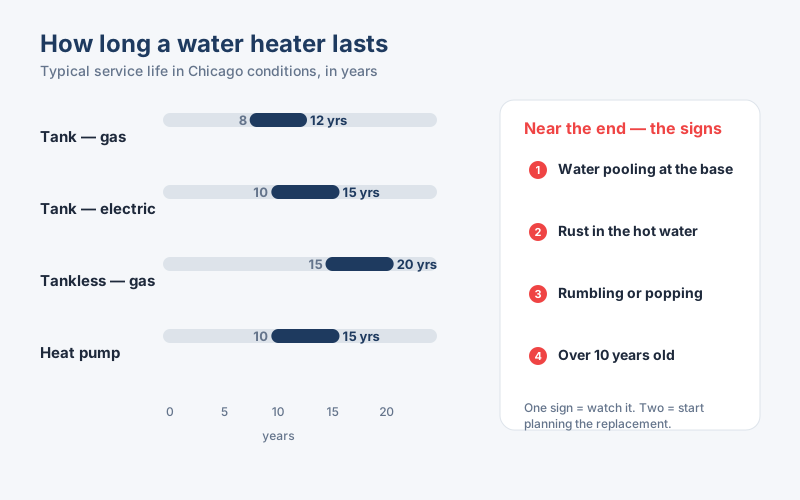
Here are the average life expectancies, based on manufacturer data and our field experience at Plumbers 911 Chicago:
| Water Heater Type | Average Lifespan | Maximum with Excellent Maintenance |
|---|---|---|
| Gas tank (40-50 gal) | 8 - 12 years | 15 years |
| Electric tank (40-50 gal) | 10 - 15 years | 18 years |
| Gas tankless | 15 - 20 years | 25 years |
| Electric tankless | 15 - 20 years | 25 years |
| Heat pump (hybrid) | 10 - 15 years | 20 years |
| Solar (direct) | 20 - 30 years | 40 years |
| Indirect/boiler-fed | 15 - 25 years | 30 years |
In Chicago specifically: Expect the low end of these ranges. Our water is moderately hard (~8 grains per gallon), which accelerates sediment buildup and anode-rod consumption — the two biggest factors in premature water heater failure.
What Actually Determines How Long Your Water Heater Lasts?
Four factors dominate. Control these and you can add 5-8 years to your unit's life.
1. Water Quality (Hardness + Sediment)
Hard water is the #1 water heater killer. Calcium and magnesium minerals precipitate out of solution when water is heated, settling as sediment at the bottom of the tank. This sediment:
- Insulates the burner (gas) or heating elements (electric) from the water, forcing longer run cycles
- Corrodes the tank floor from the inside
- Consumes the anode rod faster
- Reduces efficiency by 20-30% over time (your gas bill creeps up)
Chicago water hardness varies by neighborhood — see the City of Chicago Department of Water Management reports. Most areas see 7-9 grains per gallon. A whole-house water softener can double your water heater's lifespan.
2. Anode Rod Condition
Every tank water heater contains a sacrificial anode rod — a long rod of magnesium or aluminum suspended in the tank. Its purpose is to corrode instead of the steel tank itself. When the anode rod is fully consumed (typically every 3-5 years in Chicago's water), the tank begins to rust from the inside.
This is the single best thing you can do to extend water heater life: have a plumber replace the anode rod every 3-5 years. Payoff: 5-10 years of additional tank life.
Most homeowners have never replaced their anode rod. They don't know it exists. When we pull one out during a service call at an 8-year-old heater, it's usually fully consumed — meaning the tank has been corroding from the inside for 3+ years.
3. Installation Quality
A water heater installed incorrectly will fail early no matter how well you maintain it. Common installation errors that shorten lifespan:
- Wrong gas valve orientation — doesn't seal properly, causes soot buildup
- Insufficient gas line size — causes short-cycling, damages burner
- No expansion tank where required by code — causes pressure spikes that stress tank welds
- No dielectric unions — causes galvanic corrosion at the inlet/outlet
- Undersized relief line — T&P valve can't dump pressure properly in an emergency
- Missing or leaking sediment trap on gas line — debris damages valve and burner
Chicago's 2018 Plumbing Code requires permits for water heater installation. Professional installation from a licensed plumber means every one of these details is correct.
4. Maintenance Schedule
Most homeowners never service their water heater. That's why most last only 8-10 years. With basic annual maintenance, the same unit easily hits 15.
What a plumber's annual service visit covers:
- Flushing the tank to remove sediment
- Testing the T&P (temperature & pressure) relief valve
- Checking the anode rod (every couple of years)
- Inspecting the burner chamber (gas) or heating elements (electric)
- Checking for corrosion at inlet/outlet, relief valve, and drain
- Verifying the thermostat setting (120°F is ideal — higher accelerates mineral buildup)
- Checking expansion tank pressure (should match home water pressure, usually 50-60 PSI)
Signs Your Water Heater Is Near the End of Its Life
The insidious thing about water heater failure is that it happens slowly over years, then catastrophically in one moment (a burst tank floods your basement). Watch for these warning signs:
Early Warnings (5+ years left)
- Higher gas/electric bill without higher usage — sediment is reducing efficiency
- Longer recovery time after heavy use — also a sediment issue
- Small rust flakes in hot water — tank interior starting to corrode
- Anode rod fully consumed when checked
Mid-Stage (2-5 years left)
- Hot water has metallic smell or taste
- Brown or rust-tinted hot water (but cold water is clear)
- Rumbling, popping, or banging sounds during heating — sediment has hardened into chunks
- Minor leaks at fittings (NOT at the tank body)
- Pilot light won't stay lit (gas) or elements failing repeatedly (electric)
Late-Stage (replace now, 0-12 months left)
- Leaking from the bottom of the tank — terminal, will fail completely soon
- Moisture or rust around the base of the unit
- Significant rust coloration in all hot water
- Completely inconsistent temperature (cold, then hot, then cold)
- T&P relief valve discharging regularly — the tank is over-pressurized
Do not wait if you see late-stage signs. A tank failure floods your basement within 6-8 hours, causing water damage, mold remediation, and replacement costs that dwarf the price of a planned swap.
Learn about water heater repair vs. installation/replacement.
Tank vs. Tankless — Lifespan Economics
A tankless water heater costs on the order of double a tank installed, and typically lasts about twice as long. Tankless units are meaningfully more efficient (0.82-0.98 EF vs 0.58-0.70), but in Chicago the energy savings alone rarely close that upfront gap inside a tank's life. Counter-intuitively, tanks are often cheaper long-term — BUT tankless provides endless hot water, saves space, and has higher resale value. Read our tank vs tankless guide for a full comparison.
How to Check Your Water Heater's Age
Every water heater has a date code in its serial number. For most major brands:
- Rheem / Ruud: first 4 digits = MMYY (month-year). Example: `0819` = August 2019
- AO Smith / State / American: First 2 digits = year, next 2 = week. Example: `1842` = week 42 of 2018
- Bradford White: First letter = year (rolling 20-year cycle), second letter = month (A=Jan, B=Feb, etc.)
- Rinnai (tankless): printed date is direct — "Mfg. Date: 04/2020"
If your unit is:
- <5 years old and acting up — repair it
- 5-10 years old and acting up — assess case-by-case
- 10+ years old and acting up — replace it (the next failure will be the last one)
- 12+ years old even if working — replace proactively
How to Maximize Your Water Heater's Lifespan
Follow this 3-step program and you'll likely get 15+ years out of any quality tank unit.
Year 1 — Install It Right
- Use a licensed plumber (permit required in Chicago)
- Ensure proper expansion tank, T&P relief line, dielectric unions, and gas line sizing
- Set thermostat to 120°F (hotter wastes energy and builds sediment faster)
- Add a sediment pre-filter on the cold inlet if your water is hard (usually worth it in Chicago)
Years 2-15 — Maintain It
- Annual flush and inspection by a plumber
- Anode rod check on that same visit, replaced on schedule
- T&P valve test annually by a plumber
- Check for leaks monthly yourself — look at the base, fittings, and relief line
- Keep 18+ inches of clearance around the unit for safety and airflow
Years 10+ — Plan the Replacement
- Start getting quotes so you know your options when it fails
- Consider upgrading — tankless, heat pump, or high-efficiency tank
- Schedule replacement proactively rather than during a failure emergency
Water Heater Replacement Cost in Chicago
In rough order: a like-for-like tank swap is the low end. A high-efficiency or heat pump unit sits above that, and a tankless conversion runs on the order of double once the gas line and venting are included. Commercial or high-capacity tanks are higher still. An honest quote includes the unit, labor, permit, and haul-away of the old one; non-standard work (a new gas line, relocating the unit, an electrical upgrade) adds to it — get the full price for your house before any work starts.
Chicago-Specific Issues That Shorten Water Heater Life
- Water hammer — Chicago's older cast iron and copper plumbing sometimes has unabsorbed pressure spikes. These stress tank welds. An expansion tank solves it.
- Combustion air restrictions — Many Chicago basements are tightly sealed and don't supply enough air to gas burners. The burner runs rich, produces soot, and fails early. Gas heaters need proper combustion air per code.
- Freezing crawlspaces — Water heaters in unheated garages or crawlspaces (rare but exists) can freeze and crack. Relocate or protect.
- Hard water — Addressed above; biggest single factor.
- MWRD requirements — Large commercial installations may need backflow prevention. Confirm with your plumber.
When to Call a Plumber Immediately
Don't wait for a scheduled appointment if you notice:
- Active leaking from the tank body (not just fittings)
- T&P relief valve continuously discharging
- No hot water AND strong gas smell — turn off the gas supply and evacuate
- Flooding basement — shut off water and gas supply, then call us at 833-758-6911
- Rust-colored water from all fixtures (hot AND cold) — possible contamination
- CO alarm going off near the heater — turn off the gas, evacuate, call 911, then us
FAQ
Should I repair or replace a 10-year-old water heater? Depends on what's wrong. If it's a thermostat, pilot assembly, or anode rod — repair. If it's the tank itself (leaks, severe rust, tank-related failures) — replace. At 10+ years, we generally recommend replacement unless the fix is a small one.
Is a tankless water heater worth it in Chicago? For some households yes, for others no. If you regularly run out of hot water, have a large family, or want space savings, tankless is a strong yes. If your current tank meets demand, the roughly double upfront cost is hard to justify purely on energy savings.
How much does it cost to flush a water heater? A routine service-call item. Having a plumber do it annually is the single best maintenance habit.
Can I extend the warranty by registering? Yes — most manufacturers require registration within 30-90 days of installation for full warranty coverage. Don't skip this step.
Why is my anode rod orange or white? It's doing its job — those are the byproducts of the rod's corrosion. A rod that's more than 50% consumed needs replacement.
Water heater problems? Our water heater repair and installation team is available 24/7. Call Plumbers 911 Chicago at 833-758-6911 for diagnostics, repair, replacement, or a free lifespan inspection of your current unit.