
What Is a Garbage Disposal?
A garbage disposal is a small but powerful electric appliance installed underneath your kitchen sink, between the sink drain and the P-trap. Its job is to shred small food scraps into tiny particles — fine enough to flow safely through your home's drain lines and into the municipal sewer system (or septic tank). A properly-used disposal prevents clogs, reduces kitchen waste, and makes cleanup faster.
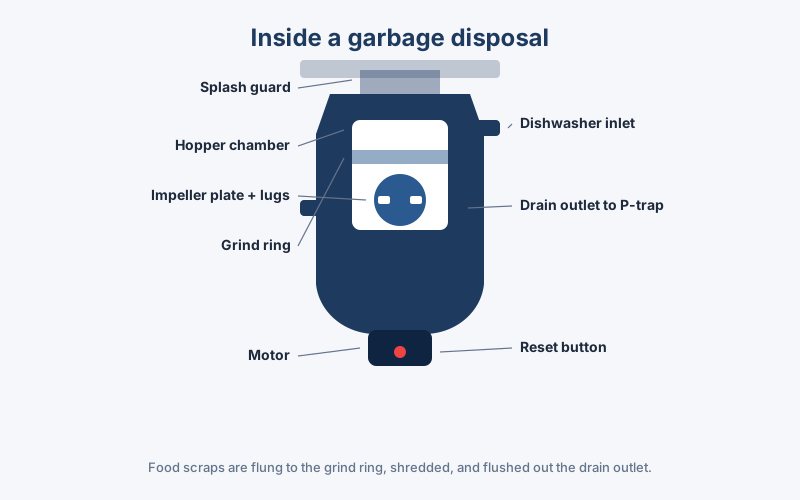
At Plumbers 911 Chicago, we install, repair, and replace garbage disposals across Chicago and the surrounding suburbs every week. This guide explains exactly how they work — so you can use yours smarter, diagnose problems faster, and know when a repair is worth it.
The 5 Main Components of a Garbage Disposal
Every modern garbage disposal — whether it's a 1/3 HP builder-grade unit or a 1 HP premium InSinkErator — has the same five core components.
1. Induction or Permanent-Magnet Motor
The motor is the heart of the disposal, located in the lower cylindrical chamber (the big black drum you see under the sink). Most Chicago homes have either:
- Induction motors — quieter, longer-lasting, more torque. Found in mid-to-premium models (1/2 HP and up).
- Permanent-magnet motors — smaller, cheaper, lighter. Found in budget 1/3 HP units.
The motor spins a flywheel at 1,725 to 2,800 RPM depending on horsepower and model.
2. Flywheel + Impellers (Lugs)
Contrary to popular belief, garbage disposals do not have spinning blades. What actually grinds your food waste is:
- A circular metal flywheel attached to the motor shaft
- Two (sometimes three) impellers — blunt metal lugs that swivel freely on top of the flywheel
As the flywheel spins, centrifugal force flings the impellers outward against the food scraps, slamming them repeatedly against a stationary grind ring.
3. Stationary Grind Ring (Shredder Ring)
Fixed to the inside wall of the grinding chamber is the grind ring — a sharp-edged ring of hardened stainless steel. As the impellers force food against this ring, the food gets pulverized into tiny particles (typically 2mm or smaller).
Why this matters: The grind ring and impellers dull over time (5-8 years for residential use). When they're dull, food doesn't break down properly and starts clogging your drain. This is one of the main reasons disposals need replacement.
4. Grind Chamber + Drain Chamber
Food waste starts in the upper grind chamber (directly under the sink drain opening). Once pulverized, it's washed down through holes in the flywheel into the lower drain chamber, then out through the drain line.
5. Reset Button + Overload Protector
Every disposal has a thermal overload switch — a safety device that shuts the motor off if it overheats (usually from jamming or continuous overuse). When tripped, you'll see a red reset button on the bottom of the unit. Pressing it re-enables the motor after it cools.
The Step-by-Step Process: What Happens When You Flip the Switch
Here's exactly what happens in the 2-3 seconds after you turn on your disposal:
- You turn on the cold water and flip the wall switch
- Electricity energizes the motor, which begins spinning the flywheel at full RPM
- Gravity and water flow carry food scraps from the sink drain into the upper grind chamber
- Centrifugal force throws the impellers outward against the food waste
- Food is slammed against the grind ring repeatedly — thousands of times per minute — until it's pulverized into slurry
- The slurry is washed through small holes in the flywheel down into the drain chamber
- Water flushes the slurry out through the discharge tube, through the P-trap, and into the main drain line
- You turn off the switch, then keep the water running for 10-15 more seconds to fully clear the line
- Cold water is critical — it keeps any fats and oils solid so they get pulverized instead of melting and coating the pipes downstream
Continuous-Feed vs. Batch-Feed Disposals
| Type | How It Turns On | Pros | Cons |
|---|---|---|---|
| Continuous-feed | Wall switch controls motor; you drop food in while running | Fast, convenient, handles high volume | Louder, slight injury risk if hand slips in while running |
| Batch-feed | Only runs when a magnetic lid is inserted + twisted | Much safer (no way to run while reaching in), quieter | Slower, more cleanup, can't add food mid-cycle |
Chicago homes: Continuous-feed disposals are in ~92% of kitchens. We recommend batch-feed only if you have children or if safety is a top concern.
Horsepower Guide — How Much Power Do You Need?
| HP | Best For | Life Expectancy | Noise Level |
|---|---|---|---|
| 1/3 HP | Small apartments, single-person households, minimal cooking | 4-6 years | Loud |
| 1/2 HP | Most 2-3 person households, moderate cooking | 8-10 years | Medium |
| 3/4 HP | Families of 4+, frequent cooking, occasional tougher items | 10-12 years | Quieter |
| 1 HP | Large families, avid cooks, handles nearly anything (even small bones) | 12-15 years | Quietest |
Our Chicago recommendation: Most homes we service do best with a 3/4 HP InSinkErator Evolution or equivalent. The extra power prevents jams and lasts nearly twice as long as builder-grade 1/3 HP units.
What's OK vs. NOT OK to Put In Your Disposal
Even the most powerful disposal has limits. Here's our Chicago plumber's cheat sheet — for a much more detailed breakdown, see our guide on what you can put in your garbage disposal.
✅ Safe (with cold water running):
- Most fruit and vegetable scraps (soft)
- Small cooked meat pieces
- Cooked grains and pastas (small quantities)
- Egg shells (debatable, but generally OK)
- Ice cubes (actually help clean the grind ring)
- Coffee grounds (small amounts only — they accumulate)
🚫 Never put in the disposal:
- Grease, fats, or cooking oils (they coat pipes)
- Fibrous vegetables (celery, corn husks, artichokes, asparagus)
- Starchy foods (potato peels, rice, pasta in large quantities)
- Bones (except small fish bones in 1 HP units)
- Fruit pits, nuts, seeds
- Coffee grounds in large amounts
- Non-food items: glass, metal, plastic, rubber, paper
- Chemical drain cleaners — they damage seals and can warp the grind chamber
How Much Does a Garbage Disposal Cost to Install in Chicago?
A like-for-like swap on the existing wiring and drain is the small end. Stepping up in horsepower, or a first-time install that needs an outlet, an air gap, or drain changes, runs meaningfully more, and commercial or hard-wired installs are the top end. Get the full price before any work starts.
Permits are not typically required for residential garbage disposal replacement in Chicago — but first-time installs that modify plumbing drains or add electrical outlets may require a permit through the Chicago Department of Buildings.
Learn more about our garbage disposal installation service.
Common Garbage Disposal Problems (and What's Actually Wrong Inside)
Understanding the internals makes it easier to diagnose what's wrong when things go sideways.
It Hums But Doesn't Spin
What's happening inside: The motor is getting power, but the flywheel is jammed — usually by bone fragments, fruit pits, or a utensil that fell in. The thermal protector will cut the motor off in 10-20 seconds to prevent burnout.
What to do: turn it off and leave it off. Don't put your hand in, don't run it dry, and call; a jam is a quick visit, a disposal that trips repeatedly or leaks from the bottom is done.
It Won't Turn On At All
What's happening inside: Either no power, tripped reset button, failed motor, or failed switch.
Fix: Check the reset button first (red button on the bottom of the unit). Then check the GFCI outlet or breaker. If both are fine, the motor or switch is dead and the unit typically needs replacement.
It's Leaking
What's happening inside: One of four gasket/seal locations: the sink flange at top, the dishwasher inlet, the discharge tube, or (worst) the motor housing itself.
Fix: Flange and tube leaks are repairable. Motor housing leaks = time to replace.
It's Draining Slowly or Backing Up
What's happening inside: Usually not the disposal itself — it's the drain line downstream. Fats, oils, and under-ground food particles accumulate in the P-trap and beyond.
Fix: If plunging and hot water don't work, you likely need professional drain cleaning.
It's Excessively Loud
What's happening inside: Something foreign is rattling in the grind chamber, the motor bearings are worn, or the mounting bracket is loose.
Fix: First, shut off power and look inside (with a flashlight) for foreign objects. If the unit is 8+ years old and getting louder every year, bearings are worn and it's time to replace.
How to Extend Your Disposal's Life
Disposals are replaceable, but a well-treated unit lasts 50% longer than a neglected one. Follow these rules:
- Always run cold water during AND after use (15 seconds after turning off)
- Cut scraps small — don't stuff in large pieces
- Run it regularly — at least weekly, even if empty, to keep seals lubricated
- Clean monthly — a handful of ice cubes + rock salt + cold water for 30 seconds scours the grind ring
- Deodorize — run lemon, lime, or orange peels monthly (in small amounts)
- Never use chemical drain cleaners — they warp plastic parts and corrode the grind ring
- Never overload — feed small amounts continuously instead of dumping a full sink
When to Repair vs. Replace
| Situation | Recommendation |
|---|---|
| Minor jam or reset trip, unit <5 years old | Clear the jam, keep the unit |
| Leak at the flange (top), unit <8 years old | Reseal the flange — a small repair |
| Leak from the motor housing | Replace — housing leaks indicate internal failure |
| Won't power on, unit <5 years old | Check wiring/outlet first; if unit itself is dead, repair if under warranty |
| Won't power on, unit 8+ years old | Replace — motor replacement costs nearly as much as a new unit |
| Grinding slowly even with nothing in it | Replace — grind ring and impellers are worn |
| Visible rust on the grinding chamber | Replace — structural corrosion |
| 12+ years old, even if working | Replace proactively before a failure floods your kitchen |
Chicago-Specific Notes
- Hard water is rough on disposals. Chicago water is moderately hard (~8 grains per gallon), which builds up mineral deposits on the grind ring over time. Running ice cubes monthly helps, as does using a water softener.
- Older Chicago homes (pre-1950) often have cast iron drain lines that clog faster. A disposal can accelerate clogs if the pipes are already narrowed by decades of mineral buildup.
- Septic systems (rare in the city but common in outlying suburbs) may not handle a disposal well. Check with your septic service before adding or using one heavily.
- Municipal code: Chicago's plumbing code does not prohibit disposals, but Oak Park, Evanston, and some other suburbs have specific dishwasher-to-disposal air gap requirements.
FAQ
Are garbage disposals bad for the environment? Modern disposals use only about 1% of a household's water and less than 0.1% of its electricity. Grinding food into particles sends it to wastewater treatment plants where it's often used for biogas generation. Landfilling food waste (without a disposal) produces methane. Research suggests disposals are environmentally neutral to slightly positive in cities with modern treatment infrastructure (which includes Chicago's MWRD).
Why does my disposal smell bad? Food particles stuck above the flywheel (in the splash guard and grind chamber walls) rot over time. Clean monthly with ice + salt + citrus peels.
Is it OK to run the disposal with hot water? No. Use cold water during operation. Cold water keeps fats solid so they get ground up, not melted into pipe-coating liquid. Use hot water only when cleaning an empty disposal.
How long should I run my disposal? About 30-60 seconds per use. Long enough to hear the motor "clear out" — the sound should drop to just the water flow. Then run water for 10-15 more seconds.
Can I install a disposal myself? Technically yes, but we don't recommend it unless you have electrical and plumbing experience. Improper installation causes leaks, electrical shorts, and voided warranties. Most homeowners break even with a professional installation by the 3rd year.
Disposal not working right? Call Plumbers 911 Chicago at 833-758-6911 for expert diagnosis, repair, or replacement. We service all major brands — InSinkErator, Moen, Waste King, KitchenAid — throughout Chicago and 245 surrounding cities, 24 hours a day.