
First: is it sewer gas or natural gas?
Sewer gas smells like rotten eggs or an outhouse, it's stronger near drains, and it comes and goes with weather and water use. Natural gas is odorized to smell like rotten eggs too, but it's sharper and more chemical, and it's constant near the source. If you're not sure, treat it as natural gas: leave the house, don't flip switches, and call Peoples Gas at 866-556-6002 from outside. Sewer gas is unpleasant and, in high concentrations, unhealthy; natural gas can level a house.
Assuming it's sewer gas, here's the list. Work down it in order; the first two solve most calls.
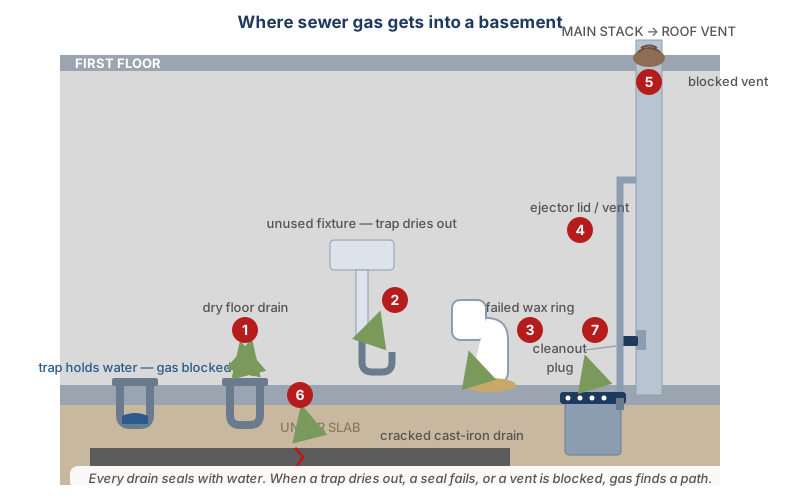
1. A dry floor drain trap (fix: a bucket of water)
Every drain in your house has a U-shaped trap that holds water. That water is the only thing between your basement and the sewer. A floor drain that hasn't had water in it for months — because nothing drains into it — dries out through evaporation, and sewer gas walks right in. In a Chicago fall, with the furnace running and the air dry, this happens fast.
Pour a gallon of water into the floor drain. If the smell fades over a day, that was it. Pour a cup of mineral oil on top of the water to slow evaporation, or make it a habit to dump a bucket in every month. If the drain is in a utility room where the furnace condensate or a humidifier drains, confirm that line is actually reaching the drain.
2. An unused fixture (fix: run the water)
Same mechanism, different drain. A basement shower nobody uses, a laundry sink, a bar sink, a toilet in a half bath that's become storage. Run every basement fixture for a minute. Flush the toilet. If one of them is the source, the smell usually goes right away.
3. A failed wax ring or loose toilet
If the basement toilet rocks even slightly, the wax seal between it and the drain flange has probably broken, and gas (and small amounts of water) escape at the base. You might see discoloration or a soft spot in the floor around it. Resetting the toilet with a new seal is a quick plumber visit; if the flange itself is cracked or sits below the finished floor, it needs a repair or spacer first.
4. The ejector pit lid or vent
If your basement bathroom or laundry drains into an ejector pit (a sealed basin with a pump that lifts waste up to the sewer line), the lid has to be gasketed and bolted down, and the pit has to be vented to the roof. A lid left loose after a pump replacement, a cracked gasket, a vent that was never connected or has come apart: all common, all smelly. Look at the pit. If you can see daylight or gaps at the lid, or the vent pipe isn't connected to anything, that's your answer. Our ejector pump page covers the setup.
Note: a sump pit (groundwater) shouldn't smell like sewer. If it does, something is draining into it that shouldn't be, which is also a code problem.
5. A plumbing vent problem
Your drain system is vented through the roof so that air can enter as water drains and gases can leave. A vent blocked by a bird's nest, leaves or ice, or a vent pipe that's disconnected in the attic, lets pressure changes siphon the water out of traps. You'll often hear gurgling at one fixture when another drains. The traps then dry and let gas in. Walk around outside and look at the vent stacks on the roof; a plumber can check from inside with a camera or smoke test.
6. A cracked or disconnected drain line
Older Chicago basements have cast-iron drain lines under the slab and in the walls. Cast iron corrodes from the inside and eventually cracks, especially at the bottom of horizontal runs. A crack above the water line lets gas out even though nothing visibly leaks. A hub joint that's lost its lead-and-oakum seal does the same. The smell tends to be persistent, localized to one area, and not fixed by any of the above. This is where a camera inspection earns its keep; a smoke test will show exactly where gas is escaping.
7. A missing or dry cleanout plug
Cleanouts are capped access points on the drain system. A cap that was left off after a rodding job, cracked, or threaded in without sealant is an open window to the sewer. Check every cleanout you can find in the basement, including the one at the base of the main stack and any in the floor.
Things that aren't sewer gas but smell like it
A dead animal in a wall or duct, a failed water heater anode producing hydrogen sulfide in the hot water (smell only when running hot water), rotting debris in a window well, and bacteria in a rarely used drain's trap (a "biofilm" smell that's more musty than sewer). The last one responds to a cup of baking soda, a kettle of hot water, and a scrub of the drain opening.
When to call
If you've poured water in every drain, run every fixture, and the smell is still there after a day, or if it's strong and constant, call 833-758-6911. Sewer gas contains hydrogen sulfide and methane; it's not a smell to live with. A union plumber from Plumbers Local 130 can smoke-test the system and find the leak without tearing anything open.