
Where the price lands, roughly
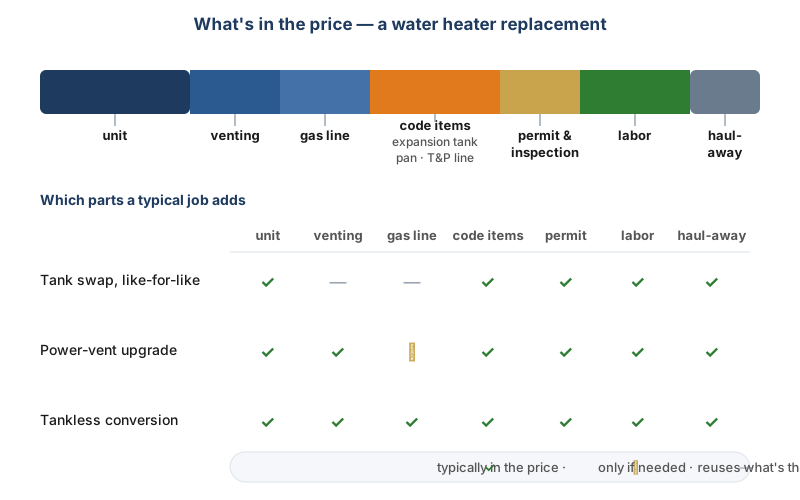
A like-for-like swap of a standard tank heater, same spot, usable vent and gas line, is the low end. A power-vent unit, or a tank swap that also needs a chimney liner or an expansion tank, lands meaningfully above that. A tankless conversion typically runs on the order of double a tank swap once the larger gas line and new venting are included, and heat pump units sit between the two. Ask for the full price for your house before any work starts; what follows is the list of things that move it.
What pushes the number up
Venting. This is the big one in Chicago's older housing. If your current heater vents into a masonry chimney along with a furnace that has since been replaced with a high-efficiency unit, the chimney may be "orphaned" — too big and too cold for the water heater alone, which causes condensation and flue deterioration. The fix is a chimney liner or switching to a power-vent heater that exhausts through PVC out a side wall. Either adds real money, and either is a code issue, not an upsell.
Expansion tank. Chicago requires one on a closed system (any house with a check valve or pressure-reducing valve on the main, which is most houses with a newer meter). If you don't have one, it gets added.
Gas line. Tankless units need a lot more gas than a tank heater while they're running. Many Chicago homes have a 1/2-inch line to the heater that's fine for a tank and undersized for tankless. Upsizing the line from the meter is a separate line item.
Location and access. A heater in a crawlspace, a tight closet, or up a flight of basement stairs with a turn costs more in labor than one sitting in an open basement by the drain. Condos with heaters in a utility closet on the 14th floor: budget for the logistics.
Drain pan and drain. Code requires a pan with a drain line where a leak would cause damage. If there's no floor drain nearby, that may mean a condensate pump or a longer run.
Electrical for a heat pump unit. Heat pump water heaters need a dedicated 240V circuit and about 700 cubic feet of air around them. In a small utility room that can mean ducting or a different location.
Permit and inspection. Chicago requires a permit for a water heater replacement and the work has to be done by a licensed plumber. The permit fee is part of the job. If someone quotes you a price that's noticeably lower than everyone else's, ask whether it includes the permit. Often it doesn't, and you find out when you sell the house.
Tank vs. tankless vs. heat pump: the honest version
Stay with a tank if your current one has served you fine, your household uses hot water in bursts (morning showers, evening dishes), and you want the lowest upfront number. A good tank heater in Chicago lasts 8 to 12 years.
Go tankless if you run out of hot water regularly, you have the gas capacity (or are willing to pay to get it), and you plan to be in the house long enough for the efficiency to matter. Expect annual descaling in Chicago's moderately hard water, or add a softener. Tankless units typically last 15 to 20 years. See our tank vs. tankless comparison for the full breakdown.
Consider a heat pump unit if you have an electric heater now, a basement with room and some ambient heat, and you want the lowest operating cost. They also dehumidify the space around them, which Chicago basements appreciate. They're slower to recover and louder than a tank; some people put them in the garage and regret it in February.
What a good quote looks like
Before any plumber starts, get the full price. A real quote names the unit (brand, model, gallons or GPM), lists the code items (expansion tank, pan, venting, gas line), includes the permit, and says what happens to the old heater. "Water heater install" plus a bare number on a tablet with no detail is not a quote, it's a number.
Ask what the permit covers and when the inspection is. Ask whether the venting was checked, not just assumed. If the installer didn't look at your chimney or gas line before pricing, the price will change on install day.
Repair vs. replace
If the tank is leaking from the body, there's no repair. If it's a gas valve, thermocouple, element or thermostat on a unit under about 8 years old, repair usually makes sense. Over 10 years with any symptom, put the repair money toward the new unit — and if it's still in the middle years, annual maintenance is what keeps it there. The five warning signs are worth a walk around the heater this month.
Timing
Water heaters fail most often in the coldest weeks of January, when incoming water temperature drops into the 40s and every plumber in the city is on frozen-pipe calls. If yours is past ten years, a planned replacement in October or November means you choose the unit instead of taking what's available at midnight.
Questions about your specific setup? Call 833-758-6911. A live person answers 24/7, and a union plumber from Plumbers Local 130 can look at the venting, gas and location before giving you a number. Get that number before any work starts.