
First, figure out which kind of backup you have
The basement floor drain is the lowest opening in your plumbing system, so it's the first place anything coming back up the sewer line will appear. What comes up, and when, tells you what's wrong.
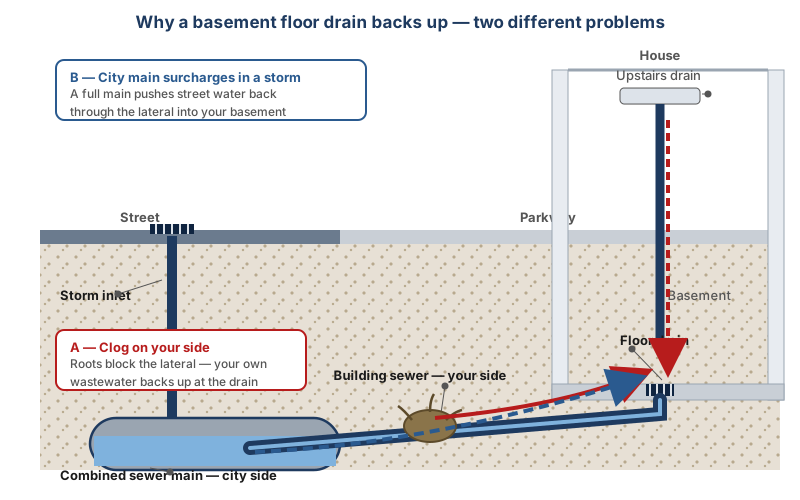
Clear or gray water, only when you run something upstairs. The washing machine drains, the shower runs, a toilet flushes, and a minute later water rises in the floor drain and then slowly goes back down. That's a partial blockage in your building sewer, the pipe between the house and the city main. Your own wastewater can't get past it fast enough, so it backs up to the lowest exit. Usually tree roots, grease, or a sagging section of pipe. It will get worse, but it's not yet an emergency if it drains back down.
Water rising with nothing running, during or right after heavy rain. That's the city side. Much of Chicago and many inner suburbs run on a combined sewer, where stormwater and sanitary waste share one pipe. In a big storm the main fills, the water level rises above the level of your basement floor, and it comes back through your floor drain and any other low fixture. This can happen with a perfectly clean private line. The water is diluted sewage; treat it as contaminated.
Dark water with solids, odor, more than one fixture affected. A full blockage of the building sewer. Everything you send down is coming back. This is an emergency regardless of weather.
Water around the drain but not from it, seeping from the floor-wall joint or cracks: that's groundwater and a sump/drain-tile problem, not a sewer backup. Different article, different fix.
What to do in the next hour
- Stop adding water. No flushing, no laundry, no dishwasher, no showers. Tell everyone in the house. Every gallon you send down comes back up.
- Don't touch the water barehanded. Even clear-looking backup water has been in a sewer. Gloves and rubber boots if you must step in it.
- Kill power to anything the water can reach. Outlets near the floor, the furnace if water is approaching it, a freezer or washer standing in it. If the breaker panel itself is in the water, don't touch it; call ComEd.
- Photograph everything before you move anything. Insurance claims for sewer backup rise or fall on documentation.
- If it's a storm backup, there's a point at which you can't do anything until the main recedes. Move what you can to higher shelves and wait. Plunging or snaking won't help; the problem is outside your property.
- If it's a clog on your side, call 833-758-6911. Describe what you're seeing, whether it's raining, and whether anything drains at all. A live person answers 24/7, and the dispatcher will tell you whether this is a tonight visit or a first-thing-tomorrow one.
What the plumber actually does
For a private-side blockage, the standard first step is rodding (cabling) the main line from a cleanout, which cuts through roots and pushes through soft blockages. In many older Chicago homes there is no exterior cleanout, so access is through the floor drain itself, a basement cleanout plug, or by pulling a toilet.
Once flow is restored, a camera inspection is the step that tells you whether this will happen again. The camera shows roots, a belly (a sag where water and solids sit), cracked clay tile sections, offset joints, or a crushed pipe. Rodding alone is a treatment; the camera shows the diagnosis. If the plumber clears the line and leaves without offering to look, ask.
If the camera shows heavy roots or grease, hydro jetting scours the pipe wall clean instead of just punching a hole through the blockage, and it lasts considerably longer. If it shows a collapsed or badly broken section, that's a repair or replacement conversation, and in Chicago that's often a trenchless lining job rather than an excavation.
Stopping storm backups for good
If your floor drain backs up every time it storms, no amount of rodding will fix it. Your options:
- A backwater valve installed on the building sewer: a flap that lets water out but closes when the main tries to push back. Effective, requires excavation in the basement floor, and some suburbs offer rebates for it.
- An overhead sewer conversion: the basement plumbing is re-routed to an ejector pit that pumps up and over to a sewer connection above flood level, so the city can't back into the basement at all. The most reliable solution and the most involved.
- A standpipe or a drain plug as a stopgap: cheap, works for minor events, and can transfer the backup pressure to the next lowest fixture (often a basement shower or toilet). Better than nothing, not a fix.
- Check whether the sump pump discharges into the sanitary sewer. It happens in older homes and it adds your own groundwater to the city's problem (and it's a code violation in Chicago).
The City of Chicago has had rebate programs for backwater valves and overhead sewers at various times; check with the Department of Water Management for what's currently offered in your ward.
What this typically costs
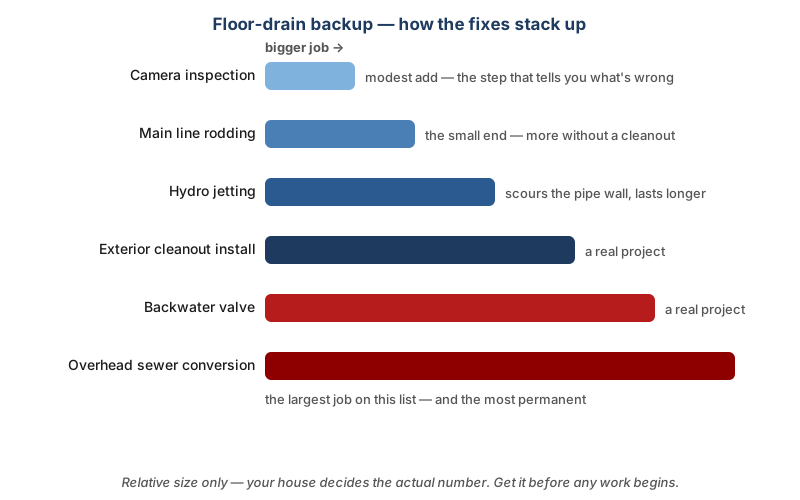
A rodding visit is the small end; a camera inspection is a modest add; hydro jetting is more; a cleanout or a backwater valve is a real project; an overhead sewer conversion is the largest job on this list and the most permanent. Get the number for your house before any work begins.
After it's cleared
Anything porous that sewer water touched (carpet, drywall below the water line, cardboard) should go. Hard surfaces get a disinfectant cleaning. If more than a small area was affected or it sat for more than a day, a water-damage restoration company is worth the call, and insurers often require one for a claim. Run a dehumidifier for several days.
Then put the camera footage somewhere you can find it. The next time a plumber tells you the line needs replacing, you'll have a baseline to compare against.
When it's an emergency
Sewage (not just water) coming up, more than one fixture affected, water reaching electrical or the furnace, or a backup that isn't receding: call 833-758-6911 now. A union plumber from Plumbers Local 130 can be dispatched around the clock, and the dispatcher can walk you through containment while you wait.