
Why Chicago is different
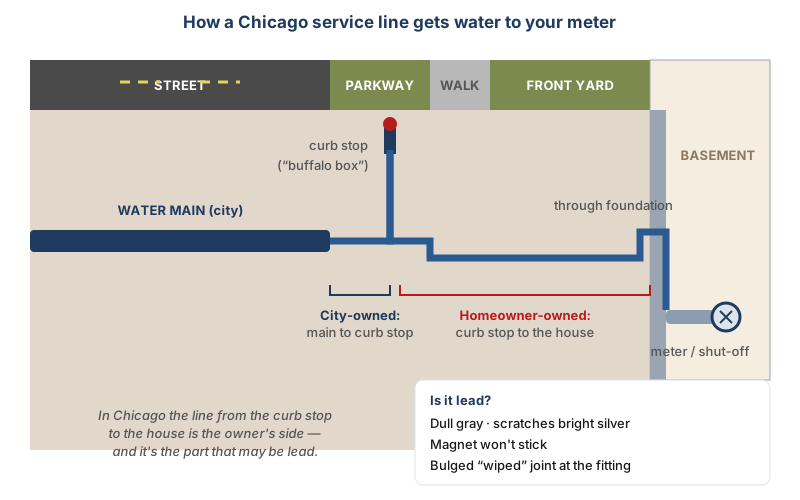
Most American cities stopped installing lead water service lines decades before the federal ban in 1986. Chicago's plumbing code required lead for the service line — the pipe from the water main in the street to your house — right up until the ban. The result is roughly 400,000 lead service lines, the most of any city in the country. If your house was built before 1986 and the service line has never been replaced, assume it's lead until you prove otherwise.
The city's water leaves the treatment plant lead-free and is treated with a phosphate blend that coats the inside of pipes to keep lead from dissolving. That works most of the time. It works less well when water sits in the pipe for hours, when the pipe is disturbed (street work, a meter installation, a water main break), and when the coating is thin. Which is why the advice below is about managing the risk now and getting the pipe out eventually.
Step 1: check your address
The City of Chicago publishes a lookup where you enter your address and see what the Department of Water Management has on record for your service line material. Records are incomplete for older houses, so "unknown" is a common and honest answer. Search "Chicago lead service line lookup" or go through the Department of Water Management's site; the city has also been mailing notices to addresses with known or suspected lead lines under the federal lead and copper rule.
Step 2: look at the pipe yourself
Go to where the water service enters the basement, usually the front foundation wall, before the meter. Find the pipe coming through the wall or up through the floor.
- Lead is dull gray, soft, and doesn't ring when tapped. Scratch it gently with a key or a coin: lead scratches easily and shows bright silver underneath. A magnet won't stick. The pipe often has a bulging "wiped" joint where it connects to the brass fitting, and it may bend rather than run straight.
- Galvanized steel is gray but hard, a magnet sticks, and the threads are visible at fittings.
- Copper is the color of a penny (or green-brown with age), a magnet won't stick, and it rings.
- Plastic is obvious.
If the pipe through the wall is copper but the house is from 1925, don't relax yet. A lot of Chicago houses had the inside portion replaced during a basement remodel while the section under the yard stayed lead. The city lookup and a plumber's inspection are how you find that out.
Step 3: reduce exposure now
Until the line is replaced, these matter:
- Flush before drinking when water has sat in the pipes for more than six hours (overnight, after work). Run the kitchen cold tap until the water turns noticeably colder, which means it's coming from the main, not the service line. Taking a shower or running a load of laundry first does the same thing.
- Cold water only for drinking, cooking and baby formula. Hot water dissolves more lead. Don't boil to remove lead; it concentrates it.
- Use a filter certified for lead — look for NSF/ANSI Standard 53 (lead reduction) on the box. Pitcher filters, faucet-mount filters and under-sink units all come in certified versions. Replace the cartridge on schedule; a spent filter does nothing. A whole-house or under-sink system with a certified lead cartridge is the set-and-forget option.
- Clean your aerators. The little screens on faucet spouts catch lead particles knocked loose by work on the line. Take them off and rinse them every few months, and right after any street or meter work.
- After any disruption — a water main repair on your block, a meter install, a water shut-off — flush for a longer period and expect the water to be cloudy at first.
- Test the water if you have young children or are pregnant. The city offers free lead-in-water test kits to Chicago residents.
Step 4: get it replaced
The 2024 federal rule requires lead service lines to be replaced nationwide. Chicago, because of the sheer number, has a longer timeline than most cities, which means waiting for the city to get to your block could take many years. The city runs replacement programs; what's offered and who qualifies changes, so check the Department of Water Management's current programs. Historically they've included free replacement for income-qualified homeowners and a program for homeowners who want to pay for their own replacement with permit fees waived.
Replacement itself is a one- to two-day job: a licensed plumber replaces the line from the house to the property line (and coordinates with the city for the portion under the street), usually by trenchless pulling of new copper through the old lead path, with excavation only at the two ends. It often makes sense to do it at the same time as water main or service work that's happening anyway, or when a sewer replacement already has the yard open. Expect to be told to flush heavily for the first few weeks after, since disturbing the old line releases particles.
What a plumber can tell you in one visit
Whether the visible pipe is lead, whether the line was partially replaced, where it runs, what the replacement would involve for your lot, and whether a filter is the right interim step. If you're buying a pre-1986 house in Chicago, add this to the inspection list; it's a real cost that belongs in the negotiation.
Call 833-758-6911 if you want it looked at. A live person answers 24/7 and a union plumber from Plumbers Local 130 can identify the material and walk you through the options.