
How you know
One faucet (or one side of the house) gives you a trickle or nothing, on a morning after a hard freeze, while other fixtures work. That's a frozen pipe. If nothing in the house works, check with a neighbor before you assume the worst; it may be the city main or your service line, and that's a different call.
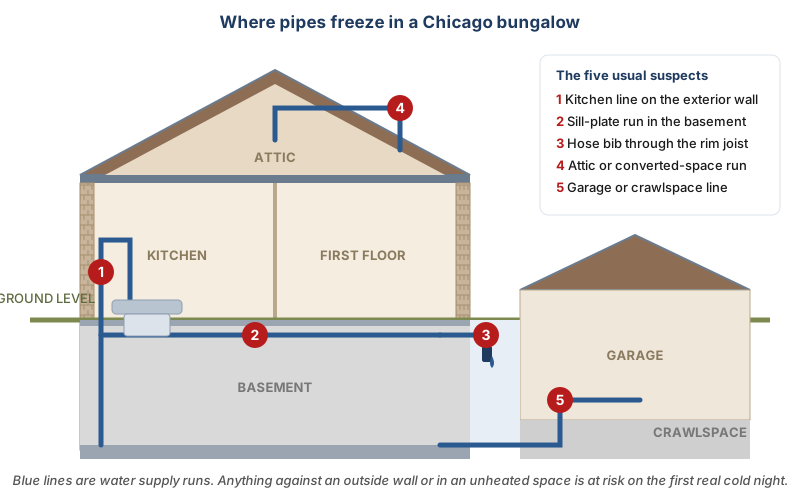
Frozen pipes mostly happen in the same places: supply lines running along an exterior wall (kitchen sinks on outside walls in bungalows are the classic), pipes in an unheated crawlspace or garage, lines near the sill plate in the basement, and anything in an attic or a converted space without enough insulation. Chicago's two-flats and brick bungalows from the 1920s have very little in the wall cavity between the brick and the plaster, and the pipes sit right in that cold pocket.
Minutes 0–5: open the faucet, find the shut-off
Open the frozen faucet both hot and cold, and leave it open. As the ice thaws, the water needs somewhere to go; an open faucet also relieves pressure building between the ice plug and the closed faucet, which is what actually bursts pipes.
Find your main shut-off right now, before you need it. It's usually in the basement on the front foundation wall where the water service comes in, before or after the meter. Make sure you can turn it. If a pipe has already split, the leak starts the moment the ice melts, and you'll want to kill the water in seconds, not minutes.
Look for the freeze. Follow the pipe from the dead faucet back toward the main. Frost on the outside of a pipe, a section that's noticeably colder, a slight bulge, or a pipe that's in an obviously cold spot (right against the outside wall, under a window, in a cabinet on an exterior wall) tells you where to work.
Minutes 5–30: thaw it, gently
Start at the faucet end and work back toward the frozen section. Thawing from the ice plug outward can trap pressure between two plugs.
Things that work:
- A hair dryer, moved steadily along the pipe. Slow, boring, and effective. Don't hold it in one spot.
- Towels soaked in hot water wrapped around the pipe, re-soaked as they cool.
- A space heater aimed at the wall or cabinet, with cabinet doors open. Warming the whole space is often what does it for a pipe you can't reach.
- Turning the house thermostat up a few degrees and opening doors to cold rooms.
Things that cause fires and burns:
- A propane torch. Every winter, Chicago has house fires started by someone thawing a pipe with a torch. It also superheats the water, which can flash to steam and burst the pipe.
- A heat gun on high held in one place, especially near wood framing or in a cabinet.
- Any open flame, a kerosene heater indoors, or a charcoal grill in the basement (yes, it happens; carbon monoxide kills).
You'll know it's working when the open faucet starts to sputter and then run. Let it run for a few minutes to flush the line, then check every inch of pipe you can see for drips.
If water shows up anywhere except the faucet
Close the main shut-off immediately. The pipe split while it was frozen, and now that it's thawed, it's leaking. A pipe that split inside a wall may show up as a stain on the ceiling below, a drip from a cabinet base, or water in the basement under the kitchen. Open the lowest faucet in the house to drain the lines, move anything the water can reach, and call 833-758-6911. This is the burst pipe repair we do all winter, and the difference between a small drywall patch and a renovation is how fast the water got shut off.
If it won't thaw
A pipe inside a finished wall or under a slab that won't respond to warming the room in an hour or two needs a plumber. Plumbers have equipment to thaw metal pipe from the inside and can decide whether opening the wall is the lesser evil. Call rather than keep going; the longer the ice sits, the more it expands.
After it's thawed: stop it happening again tonight
The pipe froze because that spot got below 32°F. It will again. For tonight:
- Leave the faucet on that line dripping, a pencil-lead stream, overnight. Moving water is far harder to freeze.
- Leave cabinet doors under the sink open so room air reaches the pipe.
- Keep the thermostat at 60°F or above, including overnight and when you're away.
- If the pipe is in a garage or crawlspace, seal the obvious drafts (an open vent, a gap around the hose bib, a garage door left cracked).
For the long term: insulate the accessible pipe with foam sleeves, and if the same line freezes every year, talk to a plumber about rerouting it to an interior wall. On the vintage-bungalow kitchen line, rerouting is usually a half-day job and ends the problem for good. If the house has galvanized supply pipe, which freezes and bursts more readily because of internal corrosion narrowing the flow, that's one of the reasons people do a repipe.
Don't wait for the thaw to find the damage
Most burst-pipe calls don't come during the cold snap. They come on the first warm day after, when ice that was holding a split pipe together melts. If a pipe froze this week, check it carefully over the next few days as the weather warms, and know where that shut-off is.
If you've got a pipe that's frozen and you're not sure what you're looking at, call 833-758-6911. A live person answers 24 hours a day and can talk you through what to do while a union plumber from Plumbers Local 130 is on the way.