
Start with the camera, not the quote
Nobody can price a sewer replacement honestly without looking inside the pipe. A camera inspection shows what's wrong (roots, cracks, offset joints, a belly, a collapse), where it is (which matters for digging), what the pipe is made of (clay tile, cast iron, Orangeburg), and how far it runs to the city connection. If someone gives you a replacement price without a camera, they're guessing, and you'll pay for the guess one way or the other.
Get the video. It's yours. You'll want it to compare quotes and, later, to see whether the problem is getting worse.
The four options, least to most
In rough order from least to most: a spot repair of one bad section; lining the existing pipe; pipe bursting; and a full open-trench replacement, which also carries the restoration cost of whatever was on top of it. Length, depth, the parkway section and the surface above the pipe move every one of these, which is why no honest number exists before a camera goes in.
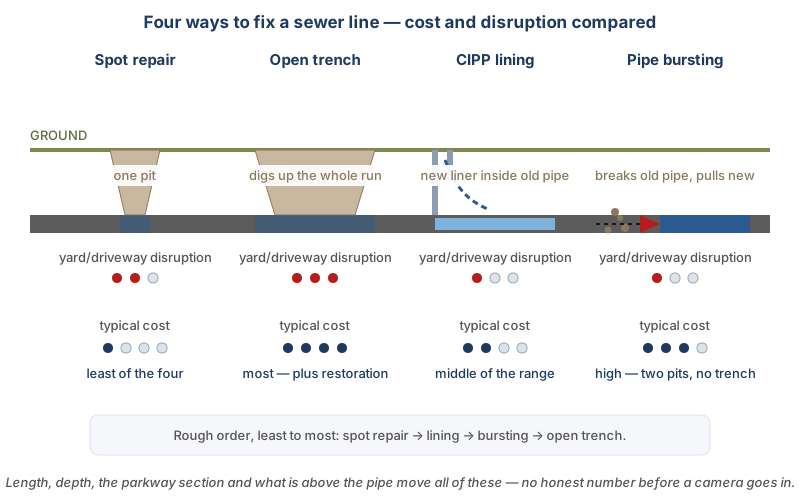
Add-ons that show up on real invoices: a new exterior cleanout if you don't have one, replacing the section under the public parkway (Chicago requires a licensed and bonded sewer contractor for that work and a separate permit), concrete or asphalt restoration, and landscaping. On a 60-foot run under a driveway with a mature tree, the restoration can cost as much as the pipe.
When each one is the right answer
Spot repair when the camera shows one bad section — a crushed joint under the parkway, a root intrusion at one hub — and the rest of the pipe is sound. It's the cheapest fix, and it's also the one that gets oversold: if the pipe is 90-year-old clay with roots at every joint, fixing one joint buys you a year.
Open-trench replacement when the pipe has collapsed (you can't line a pipe that's lost its shape), when it has a severe belly that lining would preserve, when it's shallow and under grass anyway, or when the line needs to be re-graded or rerouted. It's the most disruptive and the most certain.
CIPP lining when the pipe is structurally intact but leaking at joints, cracked, or root-infested, and you want to keep the driveway, the garage slab, the patio and the tree. The liner creates a seamless pipe inside the old one, slightly smaller in diameter. Manufacturers rate liners for 50+ years of service. It can't fix a belly, and connections from branch lines have to be reopened with a robotic cutter, which is part of the price.
Pipe bursting when the pipe is too damaged to line but you still want to avoid a trench: two pits, one at each end, and a new full-diameter HDPE pipe pulled through. Not an option where the old line sits too close to other utilities or where the soil is heavy with obstructions.
What moves the price
- Length and depth. Chicago sewers often run 6 to 12 feet deep by the time they reach the main. Deeper means shoring, more spoil, and more time.
- What's above the pipe. Grass is cheap. Concrete, pavers, a garage, a porch and a 60-year-old oak are not.
- The parkway section. The piece between your property line and the city main requires a City of Chicago permit and a licensed drain layer. Many quotes stop at the property line; ask.
- Material of the old pipe. Orangeburg (tar paper, 1940s–70s) can't be lined; it has to come out. Cast iron can often be lined. Clay tile depends on the joints.
- Access. Is there a cleanout, or does the crew need to pull a toilet or break the basement floor to get in?
- Permits, inspection, locates. JULIE utility locates are free; the permits are not.
Questions to ask before you say yes
- Can I have the camera video, with footage before and after?
- What exactly is failing, and where, in feet from the house?
- Why this method and not the other two? (A good answer references the video.)
- Does the price include the parkway connection, the permit, restoration, and a cleanout?
- Who is pulling the permit and who is doing the work — the company on the truck, or a subcontractor?
- What's the full price, and what could change it on the day?
Get all of it before work starts. Sewer work is the job where "we found something else once we opened it up" gets used to double a price, and the camera is what protects you from that.
Before you replace anything
If the camera shows roots and grease but the pipe itself is intact, hydro jetting followed by annual maintenance may be the right call for years, at a fraction of the cost. A good plumber will tell you that. If they jump straight to replacement from a backup with no camera, get a second opinion.
Call 833-758-6911 to set up a camera inspection. A live person answers around the clock, and a union plumber from Plumbers Local 130 will show you the inside of your pipe before anyone talks about replacing it.