
First: once vs. repeatedly
A pilot that went out one time after a windy night or a furnace cycle is usually a draft. Relight it once, following the instructions on the heater's label exactly, and move on. A pilot that goes out again within hours or days is not a draft. It's a part, and relighting it over and over just delays the call while the house runs out of hot water.
If you smell gas at any point, stop. Don't relight anything. Leave the house and call Peoples Gas from outside at 866-556-6002.
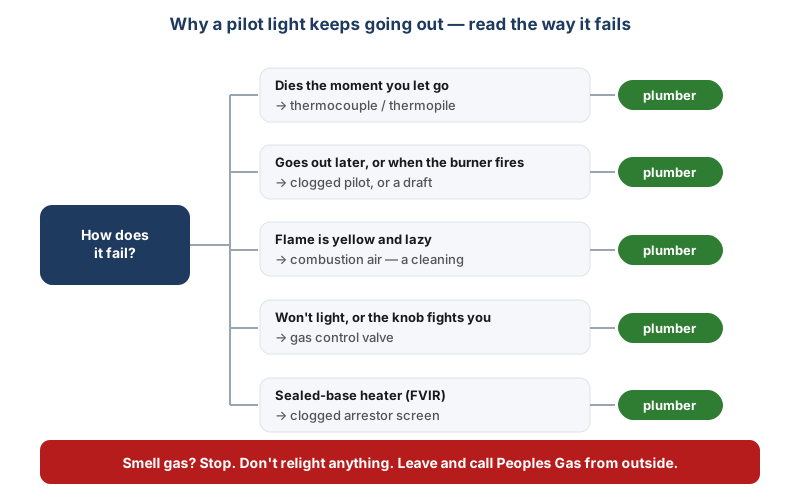
It lights, you release the button, and it dies immediately
That's the thermocouple (or on newer heaters, the thermopile). It's a small probe sitting in the pilot flame that tells the gas valve the flame is there. When it's worn, dirty, or bent out of the flame, the gas valve thinks the pilot is out and shuts the gas off the moment you let go. This is the most common cause by a wide margin, and it's a quick, inexpensive repair for a plumber. It is not a reason to replace a water heater.
It stays lit for a while, then goes out on its own
A few possibilities, and the pattern helps:
- Goes out when the burner kicks on: the pilot flame is weak or the burner's ignition is drafting it out. Often a partially clogged pilot tube or orifice; Chicago's older gas lines shed rust and sediment that end up exactly there.
- Goes out at random, more in cold weather: a draft. Look at where the heater sits. A basement window cracked for a dryer vent, a nearby return-air grille, or a flue that's backdrafting on a windy day will blow it out. A backdrafting flue is also a carbon monoxide concern and worth a plumber's look on its own.
- Goes out after running hot water a lot: can be the thermocouple again, failing only when it's hot.
The flame is yellow, lazy, or lifting off the pilot
A healthy pilot is a steady blue flame that wraps the thermocouple. Yellow and wavering means dirty combustion: a clogged pilot assembly, or not enough combustion air. Check the obvious: is the heater closet stuffed with boxes, paint cans, cat litter, or a pile of laundry? Gas appliances need air, and a sealed-up utility closet starves them. Clear the space and see if it changes. If not, it's a cleaning.
It won't light at all, or the button feels wrong
If gas won't flow to the pilot even with the control held down, or the control knob is stiff, clicks, or won't turn, the gas control valve is the likely problem. On a heater under about eight years old that's a worthwhile repair. On an older one, the valve is often the first of several parts about to go, and the money is usually better put toward a new unit.
It keeps going out, and the heater is in a sealed cabinet with a vent at the bottom
Many heaters built since the mid-2000s have a flame-arrestor screen under the burner (the "FVIR" design). When that screen clogs with dust, lint and pet hair, the burner can't breathe and the pilot or burner shuts down on a safety. The heater's label often mentions it. This is a cleaning, not a replacement, but it's a plumber's cleaning; the burner assembly comes out to do it.
What's safe for you to do
- Relight it once, per the label on the tank. If you've never done it, the label walks through it; if it doesn't light after two tries, stop.
- Clear the space around the heater and close any nearby open window or door for a day to rule out a draft.
- Look at the flame colour and note how it fails (immediately on release, or later, or when the burner fires). That description saves the plumber time.
- Check that the exhaust flue is connected and rising all the way to the chimney or wall, with no sags or gaps.
What to leave alone
The thermocouple, the pilot tube, the gas valve, the burner assembly and the arrestor screen. All of them are reachable with ordinary tools and all of them are gas work. A thermocouple replacement is a short visit for a licensed plumber; a mistake on a gas control is not a short anything.
When to call
If it's gone out more than once in a week, if the flame is yellow, if anything smells, or if you have no hot water and a house full of people. Call 833-758-6911; a live person answers any hour, including holidays, and a union plumber from Plumbers Local 130 will tell you whether it's a part or a replacement before anything is done. Get the price first.