
Why this is the November emergency nobody expects
Chicago's first hard freeze usually arrives in the last week of October or the first days of November. The burst pipes that follow in the next few weeks almost never happen outside. They happen inside the wall, a foot or two behind the outdoor spigot, and the homeowner doesn't find out until spring when they turn the hose on and water pours into the basement ceiling.
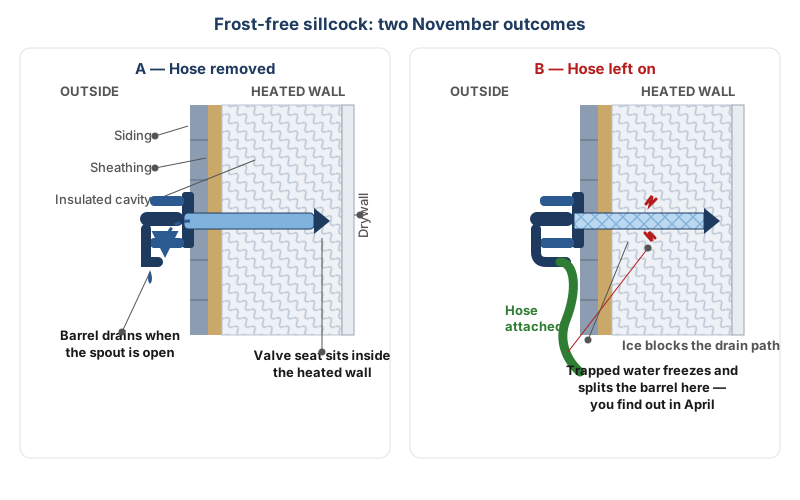
Here's the mechanism. Most Chicago homes built after the 1960s have a frost-free hose bib (also called a sillcock). The handle is outside, but the actual valve seat is 8 to 12 inches back inside the heated wall. When you shut it off, the water in the barrel drains out the spout, so there's nothing left to freeze. It works beautifully with one condition: the spout has to be open to air.
Leave a garden hose attached and the barrel can't drain. The trapped water freezes, expands about 9% by volume, and splits the copper barrel inside the wall. The split doesn't leak yet, because the valve upstream is closed and the ice is holding. In April you open the valve, water hits the split, and your wall fills up.
Older brick bungalows and two-flats often have a plain (non-frost-free) spigot with a separate shut-off valve inside the basement. Those need a different sequence, covered below.
Step 1: Disconnect every hose, splitter and timer
Do this today, not "before the freeze." Hoses, Y-splitters, quick-connects and irrigation timers all hold water against the spout. Drain the hoses by walking them out straight and lifting one end, then coil and store them. A hose left on the ground full of water will split too, which is annoying but cheap; the splitter left on the spigot is what ruins the wall.
Step 2: Figure out which type of spigot you have
- Frost-free sillcock: the spigot body is long (you may see a short pipe stub between the handle and the siding), the handle is usually a round knob or a lever, and there is often a small cap with a screw on top called a vacuum breaker. There is no separate shut-off inside.
- Standard spigot: short body, handle right against the wall. Go to the basement and look for a valve on the pipe feeding it, usually within a few feet of the exterior wall, sometimes with a small brass drain cap on the side.
Not sure? Follow the pipe from inside. If you find a valve on the line going to the outdoor faucet, you have a standard spigot.
Step 3a: Frost-free spigot shutdown
- Remove everything from the spout.
- Close the handle firmly (clockwise). Don't crank it; a frost-free valve seats with moderate pressure.
- Watch the spout for 30 seconds. A dribble that stops is normal, it's the barrel draining. If the spigot never fully stops dripping or doesn't drain, have it looked at before the cold sets in — a worn washer keeps feeding water to the barrel, and it can still freeze.
Step 3b: Standard spigot shutdown
- Close the interior shut-off valve.
- Go outside and open the spigot fully. Leave it open all winter — this lets the trapped section drain and gives any freeze expansion somewhere to go. A short horizontal run that holds water is the weak spot. This is the setup worth upgrading to a frost-free sillcock, which eliminates the yearly ritual.
Step 4: Insulated covers are a backup, not a plan
The foam dome covers sold at hardware stores slow heat loss from the spigot body. They do not stop a hose-trapped barrel from freezing, and they do nothing for a standard spigot whose interior valve is still open. Use one if the spigot is on a north-facing wall or an unheated garage, after you've done steps 1 to 3.
Step 5: Walk the rest of the house while you're at it
- Hose bibs you forgot exist: the one behind the garage, the one on the side the neighbor's fence hides, the one serving a rear deck.
- Irrigation systems: need a professional blow-out with compressed air. Draining alone leaves water in the low points.
- Pipes near the sill plate: in a basement utility area, supply lines that run along the top of the foundation wall sit against the coldest surface in the house. A foam sleeve is cheap insurance.
- Garage water lines: if the garage has a utility sink or laundry hookup and isn't heated, shut it off and drain it.
If a spigot already froze
Don't open the interior valve to "check" it. Leave the outdoor handle open, warm the wall from inside if you can (a space heater in the basement near that wall, cabinet doors open), and let it thaw on its own. When it does, inspect the barrel by opening the interior valve slowly with someone watching the wall and the spout. Any water appearing anywhere except the spout means the barrel is split. Close the valve and call 833-758-6911; this is a straightforward replacement when it's caught before the wall is soaked.
Never use a torch, heat gun or open flame on a pipe inside a wall. Thawing fires are a real and recurring Chicago problem every January.
What it costs if you skip this
A frost-free sillcock replacement is a small job. A burst barrel discovered in April after it has run into a finished basement ceiling is a plumbing repair plus drywall, insulation, flooring and sometimes a mold remediation bill. The fifteen minutes this takes is the best return on time in home maintenance.
If you'd rather have it checked, or you've found a spigot that won't stop dripping, call 833-758-6911. A live person answers 24/7, and a union plumber from Plumbers Local 130 can handle the swap before the cold arrives.