
Why empty houses flood
A burst pipe with someone home is a mess. A burst pipe in an empty house is a renovation. A 1/2-inch supply line under pressure can put out several gallons a minute. Over four days, that's enough to fill a basement, bring down a ceiling, and start mold in the walls before anyone knows. Every winter we walk into houses where a small fitting failed on Tuesday and the family came home Sunday to a foot of water.
The fix isn't a product. It's turning a valve.
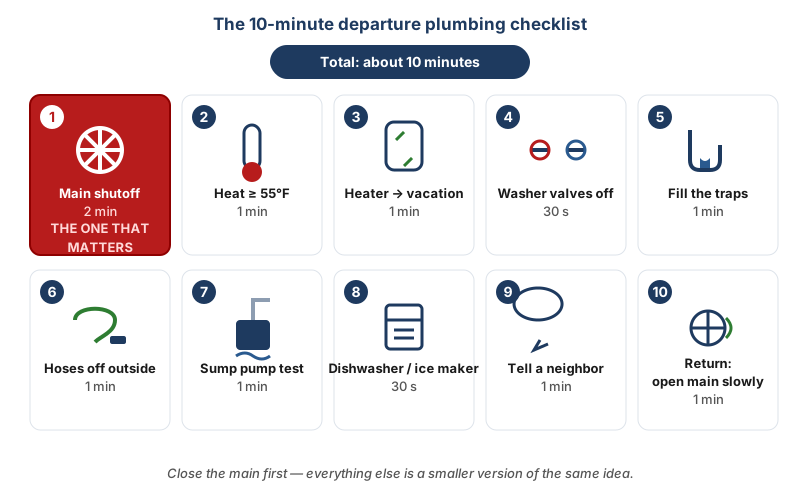
1. Shut off the main water valve (2 minutes)
Find it: basement, front foundation wall, where the water service enters, near the meter. Turn it clockwise until it stops (a lever-style ball valve turns a quarter turn until it's perpendicular to the pipe). Then open a faucet on the top floor and one in the basement; the top one lets air in, the bottom one drains the pressure out. If water keeps running at the basement faucet for more than a minute, the valve isn't fully closing. Note that for a plumber; a main shutoff that doesn't shut off is worth fixing regardless of travel.
With the main off, a pipe can still freeze, but if it splits, nothing comes out of it. That's the whole game.
If you can't shut the main off because you have a sprinkler system that needs it, a tenant, or a pet sitter who needs water: at minimum, close the shutoffs under every sink and behind every toilet, and shut the valve on the washing machine supply. Those are the most common failure points.
2. Leave the heat on, at 55°F or above (1 minute)
Not off. Not 45°F to save money. Pipes in exterior walls see temperatures well below what the thermostat reads in the hallway, and 55°F at the thermostat is about the floor for keeping those pipes above freezing in a Chicago cold snap. If you have a smart thermostat, set it so it alerts you if the temperature drops; a furnace that quits while you're away is the other classic.
Open cabinet doors under sinks on exterior walls, and open interior doors so heat circulates.
3. Deal with the water heater (1 minute)
For a trip of a few days: set a gas water heater to "vacation" or the lowest setting; set an electric unit's thermostat down or flip its breaker. Don't drain it. For a trip of several weeks in deep winter, with the main off, consider turning the gas unit to pilot. Either way, when you return, turn the main back on before restoring the water heater to normal, so the tank refills and you're not heating an empty tank.
4. Washing machine hoses (30 seconds)
Close both supply valves behind the washer. Rubber washer hoses are a top cause of indoor flooding and they fail without warning. If yours are rubber and more than five years old, have them replaced with braided stainless when you get back.
5. Drains and traps (1 minute)
Run water in every drain for a few seconds before you shut the main, so every trap is full. Full traps keep sewer gas out of the house. If you'll be gone for weeks, pour a tablespoon of cooking oil into each floor drain and rarely-used fixture to slow evaporation.
6. Outside (1 minute)
Hoses off the spigots. Frost-free spigots closed; standard spigots shut off from inside and opened outside to drain. Here's the full version. Downspouts clear and pointed away from the foundation, since a thaw-and-refreeze can push meltwater against a basement wall.
7. Sump pump (1 minute)
Pour a bucket of water in the pit and watch it pump. Make sure the discharge line outside isn't frozen or buried. If you have a battery backup, check the charger light. A sump pump failure in a wet winter stretch floods a basement from below while you're protecting it from above.
8. Dishwasher and ice maker (30 seconds)
Run the dishwasher before you go, or at least don't leave it full of standing water. The ice maker line is a thin plastic or copper tube that's a known failure point; if your refrigerator has a shutoff for it (often behind the fridge or under the sink), close it.
9. Tell someone (1 minute)
Give a neighbor or friend the key, your number, and the location of the main shutoff. A plumber can't help if nobody can let them in and nobody knows there's a problem. If you have a water leak sensor (the inexpensive kind that texts your phone), put it by the water heater and in the basement low spot.
10. The return
Turn the main back on slowly, with a faucet open upstairs to let air out. Walk the house: basement floor, under sinks, around the water heater, the ceiling below bathrooms. Listen for running water with everything off. Then restore the water heater.
If you come home to water, shut the main (if it's not already), kill power to anything wet, and call 833-758-6911. A live person answers on every holiday, and a union plumber from Plumbers Local 130 can be dispatched the same day. Get the price before any work begins. Have a good trip.