
The number on the box is a summer number
A tankless water heater is rated in gallons per minute (GPM), and the big number on the brochure, say 9.8 GPM, is measured at a small temperature rise, often 35°F. That's roughly the rise you need in Chicago in August, when water comes in from the lake at around 70°F and you want it at 105°F in the shower.
In January, the water coming into your house is in the low 40s. To get it to 105°F you need a rise of about 65°F, almost double. A tankless unit puts out a fixed amount of heat per minute, so when the rise doubles, the flow it can heat roughly halves. That 9.8 GPM unit becomes a 5 GPM unit, give or take. This is why people who installed a tankless heater in July call in January to say it's broken. It isn't; it's doing exactly what the physics says.
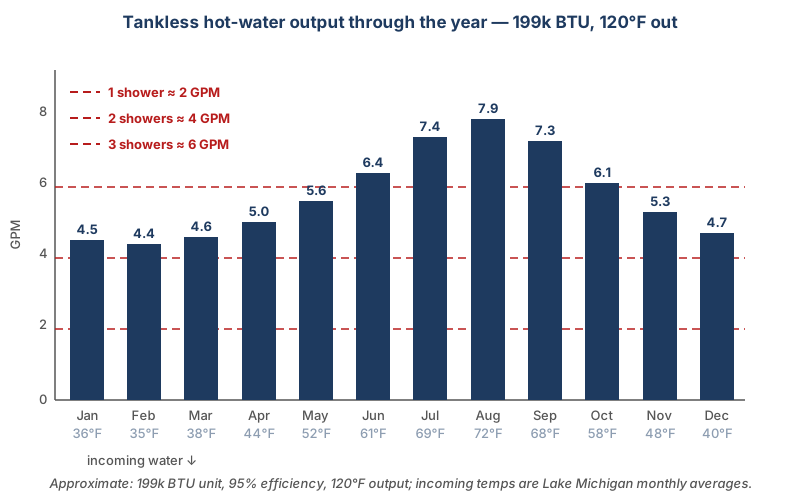
What 5 GPM actually buys you
Rough fixture flows: a modern showerhead is 1.8 to 2.5 GPM, a kitchen faucet 1.5 to 2.2, a bathroom faucet 1.0 to 1.5, a dishwasher around 1.5, a washing machine 2 to 3 on fill. So in winter, a unit delivering 5 GPM of hot water runs two showers at once comfortably, or one shower plus the dishwasher and a sink. Three showers at once, or a shower plus the washer filling with hot, and someone gets cold.
For most Chicago households of two to four people, that's fine, as long as the unit was sized for winter in the first place. For a house with two bathrooms in heavy use at 7 a.m., a two-flat with a shared unit, or a big soaking tub, it's a problem unless you size up or run two units.
Size for January, not July
When we size a tankless unit for a Chicago house, the inputs are:
- Incoming water temperature in the coldest month. Use 40°F. Not the annual average.
- Target output. 120°F at the unit (shower mixes it down).
- Peak simultaneous demand. Count the fixtures that realistically run at the same time on your worst morning, and add their GPM.
An 80°F rise at 5 GPM takes a unit rated around 199,000 BTU, which is the top of the residential range. If the demand is higher than that, the honest answer is two units, or a tank, not a single tankless with a hopeful brochure.
The gas line problem
A 199,000 BTU tankless heater draws more gas than a furnace while it's running. Many Chicago homes have a 1/2-inch gas line to the water heater, sized for a 40,000 BTU tank unit. That's not enough. The line from the meter may need to be upsized, and if the meter itself is small, Peoples Gas may need to swap it. This is a real cost, it's part of the install, and it's a reason some quotes for the same unit differ by a lot. Ask whether the gas supply was checked, not assumed.
Venting and condensate
High-efficiency (condensing) tankless units vent through PVC and produce acidic condensate that has to drain somewhere, through a neutralizer. Non-condensing units need stainless venting and run hotter. Either way, you're not reusing the old water heater flue into the chimney. In a bungalow basement, the vent run to an outside wall is usually short; in a mid-block two-flat or a condo, it can be the deciding factor.
Cold-weather issues specific to Chicago
- Freeze protection. Tankless units have built-in freeze protection that needs power. In an extended outage during a cold snap, the heat exchanger can freeze. If the unit is on an exterior wall or in an unheated space, know how to drain it, or install a battery backup for the controls.
- Intake air. If the unit draws combustion air from outside, the intake can frost over or get buried in drifted snow. Keep it clear.
- Scale. Chicago's water is moderately hard. Scale builds on the heat exchanger, reduces output, and triggers error codes. Plan on descaling once a year, or add a softener upstream.
- Cold-water sandwich. When you turn a tap off and back on quickly, you get a slug of cold water between two hot ones. It's normal; a small buffer tank or a recirculation setup eliminates it if it bothers you.
Tank, tankless, or both
A tank heater doesn't care what the incoming temperature is until it's empty; it just takes longer to recover. For a household that showers in sequence, a well-sized tank is simple and cheap. For one that wants hot water on demand all day and has the gas capacity, tankless is excellent when sized for winter. Some houses do best with a tankless unit feeding a small storage tank, which smooths out both problems. Here's the longer comparison.
If you're getting cold showers from a tankless unit this winter, the first questions are: how big is the unit, how many fixtures were running, and when was it last descaled. Call 833-758-6911; a live person answers any time, and a union plumber from Plumbers Local 130 can tell you whether it's a sizing problem, a scale problem, or a repair.