
Why this is the most important five minutes of plumbing you'll ever do
Every emergency article we write starts the same way: shut off the main. It's the step that turns a burst pipe from a disaster into a repair. And on a lot of our emergency calls, the homeowner is standing in water on the phone saying they can't find the valve, or they found it and it won't turn, or they turned it and the water kept running.
Fix that today, while nothing is wrong.
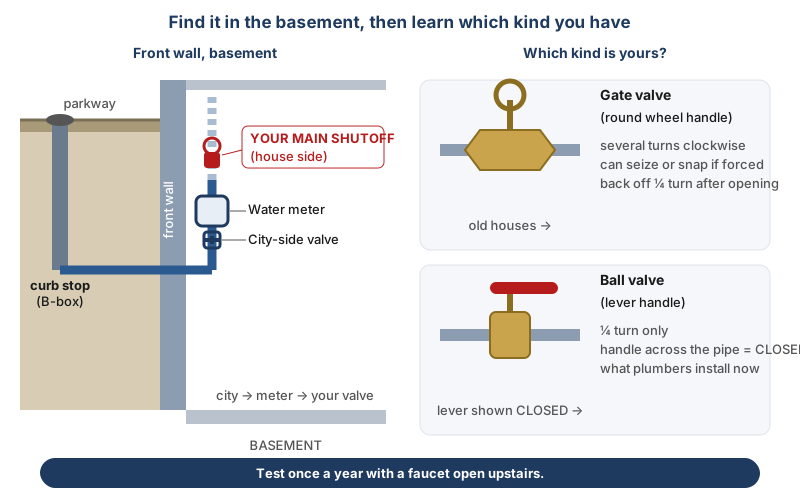
Where it is
In most Chicago houses the water service enters through the front foundation wall, in the basement or crawlspace, facing the street. Follow the largest pipe coming through that wall. Within a few feet you'll find the water meter (a brass or plastic body with a dial or digital readout) and one or two valves.
- Before the meter (street side): a valve the city considers theirs. You can use it in an emergency, but if it's stuck or leaks, call the city, not a plumber.
- After the meter (house side): your main shutoff. This is the one to know and test.
Houses with the meter outside in a pit, or with newer wireless meters, usually still have a shutoff on the house side where the pipe comes in. Condos: there's typically a shutoff for your unit in a utility closet, behind an access panel, or in the ceiling of the unit below; the building engineer knows where. Two-flats often have one main and then separate shutoffs for each unit. Find all of them.
If you truly can't find a valve inside, there's a curb stop (Chicagoans call it the buffalo box or B-box): a small round iron lid in the parkway or sidewalk near the street. It takes a long key to operate and it's the city's valve. Don't count on it; it's a last resort and in a hard freeze it may not turn.
What kind of valve you have
Gate valve: a round wheel handle, like an outdoor spigot. Turns several revolutions clockwise to close. Common on older homes. The problem with gate valves is that the gate inside corrodes and they stop closing fully, or the stem snaps when you force one that hasn't moved in 20 years. A gate valve that's been untouched for a decade is a gamble.
Ball valve: a lever handle. A quarter turn, and the handle is perpendicular to the pipe when closed. These are what plumbers install now. They close fully, they don't seize the same way, and you can operate one with wet hands in the dark. If you have a gate valve as your main, replacing it with a ball valve is one of the cheapest insurance policies in home ownership.
How to test it without breaking it
- Open a faucet on the top floor and leave it running.
- Close the valve. Ball valve: quarter turn. Gate valve: turn clockwise slowly, by hand, until it stops. Don't use a wrench on the handle of a gate valve; if it won't turn by hand, stop. A stuck gate valve forced with a wrench can snap the stem off and leave the valve half open permanently.
- Watch the faucet. It should slow to a trickle and stop within a minute or so as the pipes drain. If it keeps running, the valve isn't sealing.
- Open the valve again — all the way, then back a quarter turn on a gate valve (this keeps the gate from wedging). Check the valve for drips at the stem; a gate valve that drips at the stem after use needs a plumber's attention.
- Flush the lines: run the faucets for a minute to clear any sediment the test knocked loose.
Do this once a year. The valve stays workable, and you stay familiar with it.
If it won't close, or won't fully close
Don't force it. A main valve that doesn't seal is a job for a plumber, and it's a planned job, not an emergency: the city shuts the water at the curb stop (or the plumber does, with the right key and permit), the old valve comes out, a ball valve goes in. If the pipe coming through the wall is lead or old galvanized, the plumber will tell you; that's a separate conversation about the service line.
Label it and share it
Hang a tag on the valve: "MAIN WATER SHUTOFF — turn clockwise / lever perpendicular to close." Take a photo and put it in a shared album with everyone in the house and whoever watches the place when you travel. If kids are old enough to be home alone, show them. In a burst-pipe situation, the person who knows where the valve is saves the house.
The other shutoffs worth knowing
- Water heater: valve on the cold inlet on top. Close it if the tank leaks.
- Toilets and sinks: the small chrome valves at the wall. Test them; the cheap multi-turn ones often fail to close — worth having them replaced with quarter-turn valves.
- Washing machine: two valves behind the machine. Close them when you travel.
- Outdoor spigots: interior shutoffs for standard hose bibs. Winterizing guide here.
- Gas: separate topic, separate valve, at the meter. If you smell gas, leave and call Peoples Gas from outside.
If your main shutoff is a gate valve you're nervous about, or you can't find one at all, call 833-758-6911. A live person answers around the clock, and a union plumber from Plumbers Local 130 can replace it with a proper ball valve and show you how it works before leaving.