
Why it leaks now and not when it was frozen
When water freezes in a pipe it expands by about nine percent. Something has to give: the pipe wall splits lengthwise, a soldered joint lets go, or a compression fitting backs off. But while the ice is still in there, the ice is the plug. Nothing comes out of the split because the split is full of ice. The pipe "fixes itself" when it thaws, water starts flowing again, and that same water now has a new way out.
That's why burst-pipe calls peak on the first warm day after a cold snap, not during it. If a faucet in your house stopped running during the cold and then came back on its own, assume that section of pipe is damaged until you've looked.
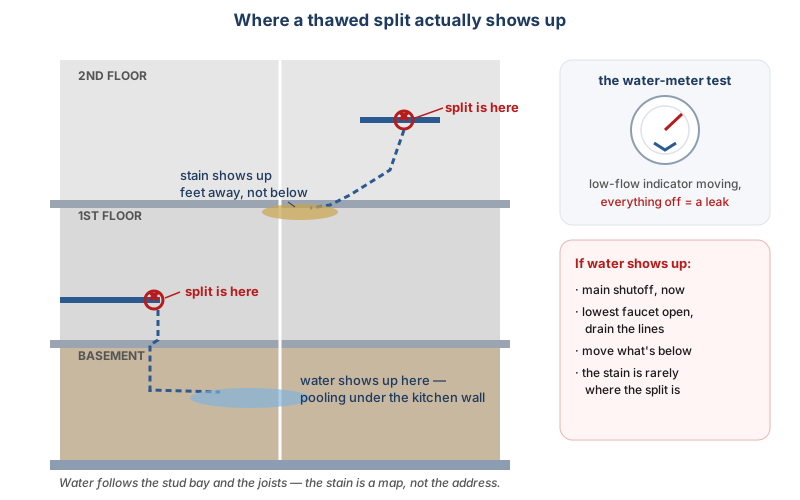
Where to look
At the fixture that froze. Open the cabinet. Look at the pipes, the back wall, the cabinet floor, the shutoff valves. A split copper line often shows as a thin spray or a weep along a seam; a failed joint drips at the fitting.
Below it. Water follows gravity and framing. A split kitchen line on the first floor shows up as a stain on the basement ceiling, a drip from a light fixture, or a wet spot on the basement floor under the kitchen wall. A split bathroom line on the second floor shows up in the ceiling of the room below, often several feet from where the pipe actually is.
At the water meter. Turn off every fixture in the house and watch the meter's low-flow indicator. If it moves, water is going somewhere. This is the single most useful check when you suspect a leak you can't see.
Along the exterior wall in the basement. Walk the perimeter with a flashlight. Look at the sill plate area where the supply lines run, and at any pipe passing through the rim joist to an outdoor faucet.
Outside. An ice sheet forming on the ground under a hose bib after the thaw means the frost-free barrel split inside the wall and is now draining out through the siding or the foundation.
What to do right now
If water is actively coming out: main shutoff, then open a faucet on the lowest floor to drain the lines. Move anything the water is reaching. Photograph everything. Call 833-758-6911.
If it's a stain or a damp spot with no active flow: shut the main anyway until a plumber has looked. A slow weep inside a wall is doing damage every hour, and a slow weep can become a spray the next time the pressure spikes.
What the repair conversation will be
A single split or failed joint, accessible: the plumber cuts out the damaged section and replaces it. Short visit. They'll pressure-test afterward, because a freeze that split one spot often weakened the fittings on either side.
Inside a finished wall or ceiling: the plumber needs to open the wall to reach it. Expect them to use leak-detection equipment first to pinpoint the location so the opening is small and in the right place. The patch afterward is a drywall job, not a plumbing one.
Several splits along one run: replacing the whole run is often cheaper and more reliable than chasing splits. On a line that froze because of where it is, the plumber may recommend rerouting it to an interior wall at the same time so it doesn't happen next year.
Galvanized steel pipe: a freeze on old galvanized tends to reveal how corroded the whole system is. Cutting out one section can crumble the next. This is where the repipe conversation starts, and it's worth having honestly rather than paying for a series of patches.
PEX: it tolerates freezing better than copper, but the brass fittings and the manifold don't. Leaks after a freeze on PEX are usually at the fittings.
Insurance
Sudden and accidental freeze damage is generally covered, with the usual condition that the heat was on. Document everything before cleanup, get the plumber's invoice to state the cause, and call the insurer the same day. The full rundown on what's covered and what they'll ask.
The question to ask before the plumber leaves
"Why did this pipe freeze, and what stops it next time?" The answer is one of: insulation, air-sealing the gap that lets cold air at the pipe, a heat cable, or moving the pipe. A plumber who's just fixed the split can see exactly which it is. Here's the background on what works in Chicago's housing stock.
Call 833-758-6911 any hour. A live person answers, and a union plumber from Plumbers Local 130 can be dispatched. Get the price before the work starts.