
The bungalow problem
Chicago has roughly 80,000 brick bungalows, most built between 1910 and 1940, plus the two-flats and greystones of the same era. They're solid houses. They're also, from a plumber's point of view, a cold wall with pipes in it. The exterior walls are brick, then a small air gap or furring strips, then plaster. There's little or no insulation in that cavity. A kitchen sink on an exterior wall, which is how most bungalow kitchens were laid out, has its supply lines sitting in a pocket that tracks the outside temperature closely.
The internet's standard advice, "wrap your pipes in foam," was written for houses where the pipe is the coldest thing in an otherwise insulated wall. In a bungalow, the pipe is a warm thing in a cold wall, and a foam sleeve slows heat loss for a few hours before the pipe reaches the wall's temperature anyway. It helps. It's not a solution on its own.
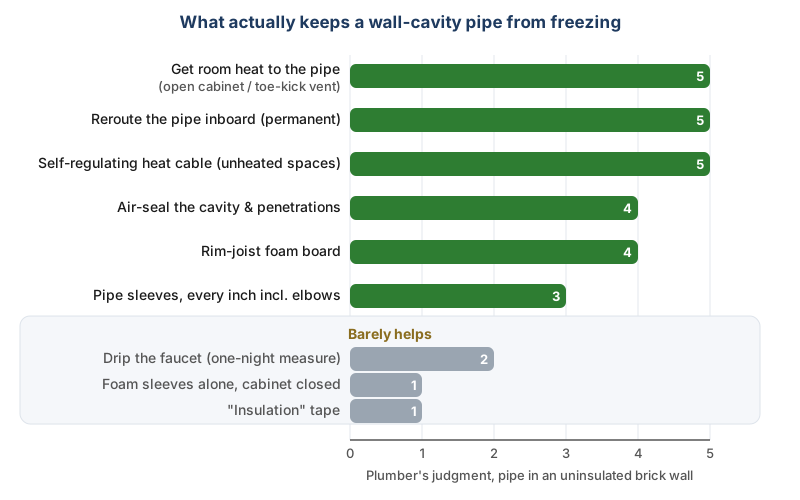
What actually works, in order
1. Get heat to the pipe. The reason bungalow kitchen lines freeze is that the cabinet doors are closed and the pipe is sealed off from the room. Open the cabinet on cold nights. Cut a vent grille into the cabinet toe-kick or the cabinet base so room air circulates year-round. If there's a heating register near the sink, make sure it isn't blocked by a rug or a trash can. This costs nothing and does more than any product.
2. Have the cavity air-sealed. Cold air moving through the wall cavity is worse than cold air sitting in it. The entry points: gaps around the hose bib where it penetrates the wall, the sill plate where the framing meets the foundation, holes where pipes come up from the basement, old dryer vents, abandoned conduit. Spray foam around the penetrations, caulk at the sill plate, foam in the rim joist bays — a Saturday job for a handy owner, and it lowers the gas bill too.
3. Insulate the basement ceiling perimeter and rim joist. In most bungalows, the supply lines run along the basement ceiling near the exterior wall, right against the rim joist, which is the coldest wood in the house. Foam-boarding the rim-joist bays is the highest-return insulation job in an old Chicago house — an insulation contractor or a handy owner can do it.
4. Insulate the pipe itself, properly. Now the foam sleeves help. Use closed-cell foam or fiberglass pipe wrap rated for the pipe diameter, seal the seams, and cover every inch — if you do it yourself, the elbows and the stretch behind the sink are where gaps get left, and gaps are where the freeze starts. For pipes in an unheated crawlspace or garage, go thicker: 1-inch wall or a fiberglass wrap with a vapor jacket.
5. Heat cable where nothing else reaches. Self-regulating heat cable keeps a pipe above freezing regardless of the wall — it's the right answer for a line in a crawlspace, a garage, or a cantilevered bay. Have a plumber or electrician install self-regulating cable; it must match the pipe material, and it should never be overlapped. It uses electricity only when it's cold enough to matter.
6. Reroute the pipe. For the pipe that freezes every winter despite all of the above, the permanent fix is moving it. In a bungalow kitchen that usually means running the supply up through the floor from the basement a foot or two inboard of the wall, inside the cabinet, instead of inside the wall. A plumber can do it in half a day; the pipe stays in conditioned space forever. If the house still has galvanized supply pipe, which freezes more readily because the inside is narrowed by corrosion, this is the point where a repipe comes up.
What doesn't work (or barely)
- Foam sleeves alone on an exterior-wall pipe, with the cabinet closed and the wall uninsulated. Delays the freeze; doesn't prevent it.
- Dripping the faucet as a strategy rather than a one-night emergency measure. It works (moving water resists freezing) but it wastes water, and it does nothing if the frozen section is upstream of the faucet's branch.
- "Pipe insulation" tape wrapped around a pipe like a bandage. It's a vapor barrier, not insulation.
- Blowing cellulose into the wall cavity of a brick bungalow without dealing with moisture. Insulating the wall between the pipe and the room can actually make the pipe colder by cutting it off from room heat. Wall insulation in these houses is a bigger conversation with an energy contractor.
- Space heaters left running unattended near a pipe. Fire risk, and the furnace was already doing this job.
Where to look in your house
Walk the basement perimeter with a flashlight on a cold evening. Feel the rim joist above the foundation. Feel the pipes near it. Any place you feel a draft or a notably cold pipe is a spot on the list. Then go upstairs and open the kitchen cabinet; if the back wall feels cold, that pipe is at risk.
Prioritize: the kitchen exterior wall line, the sill-plate runs, the hose bib penetrations, any pipe in an unheated space. Here's the outdoor-faucet side of this, and what to do if a pipe has already frozen.
If you'd like a plumber to walk the basement with you and point at the three things worth doing, call 833-758-6911. A live person answers any time, and a union plumber from Plumbers Local 130 has seen the inside of more bungalow walls than anyone. Get the price before any work starts.