
First, is it pressure or flow?
They feel the same at the tap but they're different problems. Pressure is the push behind the water: if a faucet opened on its own would spray hard or dribble. Flow is how much water actually gets through a pipe when it's open. A house can have fine pressure and poor flow because the pipes are narrowed. In old Chicago houses, most "low pressure" complaints are actually flow problems, and winter makes several of them worse.
A quick way to tell: does the problem get noticeably worse when two fixtures run at once? That's flow. Is it weak even with one tap open and nothing else running? That could be either.
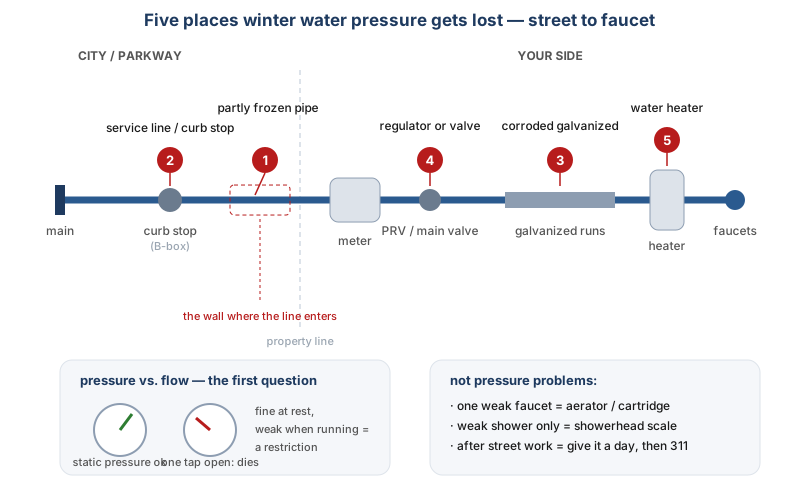
1. A partially frozen pipe
The most urgent one. Water still flows, but less, because ice is narrowing a section of pipe. It's usually one branch: a bathroom on an exterior wall, the kitchen, a hose bib line. If one area of the house is weak and the rest is normal on a very cold day, treat it as a freezing pipe: leave the faucet open a little, warm the space, and call before it stops entirely. What to do in the first 30 minutes.
2. The service line, or the curb stop
The pipe from the street to the house runs under the parkway at a depth that's usually below the frost line, but not always, and not everywhere along its length. An old lead or galvanized service line can also be so narrowed by decades of mineral buildup that any additional restriction, including the city throttling a main during a nearby break, shows up as weak flow throughout the house. The curb stop valve in the parkway can also be partially closed after utility work. If the whole house is weak, including the first fixture after the meter, the restriction is before the house. A plumber can check pressure and flow at the meter to confirm, and if the service line is lead it's a replacement conversation regardless.
3. Galvanized supply pipe
The big one in pre-1960 Chicago housing. Galvanized steel corrodes from the inside; a 3/4-inch pipe can have a 1/4-inch opening after sixty years. Flow gets steadily worse over years, and winter makes it worse still because colder water is slightly more viscous and because people run more hot water (the hot side of galvanized systems corrodes faster). Signs: the hot side is weaker than the cold, the upstairs is weaker than the downstairs, flow drops sharply when a second fixture runs, and the water runs rusty after it's been sitting. There's no cleaning galvanized pipe; the fix is replacing it, and most people do it in sections starting with the worst run.
4. The pressure regulator or the main valve
If the house has a pressure-reducing valve on the main (a bell-shaped brass fitting after the meter), they fail in two directions: too much pressure, or too little. One that's failing closed gives a weak house that's weak everywhere, cold and hot equally, upstairs and down. Separately, a main shutoff valve that was partly closed after work and never fully reopened does the same thing. Both are quick for a plumber to diagnose with a gauge, and the fix is a part, not a project.
5. The water heater
If only the hot side is weak throughout the house, look at the heater. Sediment in the bottom of the tank, a failing dip tube, or scale in a tankless unit's heat exchanger all restrict hot flow. On a tankless unit this is the classic winter complaint: the unit throttles flow to maintain temperature when incoming water is 40°F, so hot flow drops in January even though nothing is broken. Why that happens.
Things that look like pressure problems but aren't
- One faucet weak, everything else fine: a clogged aerator (the screen on the spout) or a failing cartridge — a quick fix either way.
- Shower weak, sinks fine: a scaled showerhead or the shower valve's cartridge.
- Weak after street work on your block: air and sediment in the lines, usually clears in a day; also, the city may have partially closed your curb stop. Give it a day, then call the city's 311 line before a plumber.
What a plumber actually does on this call
Puts a gauge on an outside spigot or the laundry connection to read static pressure, then watches it under flow. Checks at the meter to split "before the house" from "in the house." Looks at the pipe material and the age of the valves. In fifteen minutes the problem is usually narrowed to one of the five above, and the conversation is about which fix makes sense for a house you plan to be in for however long you plan to be in it.
If the pressure dropped suddenly in a cold snap, call 833-758-6911 today; that's the freezing-pipe case and it doesn't wait. If it's been slowly getting worse for years, call when you're ready to deal with it properly. A live person answers either way, and a union plumber from Plumbers Local 130 can be dispatched. Get the price before any work starts.