Why rentals freeze more than owner-occupied homes
The person living in the unit doesn't own the pipes. They don't think about the kitchen cabinet on the exterior wall, they turn the heat down to save on a bill they pay, and if a faucet stops running on a Sunday they may not mention it until Tuesday. An empty unit is worse: no one is there to notice anything until the ceiling below gives way. Chicago's two-flats and three-flats add the specific problem of a vacant upper unit sitting over an occupied one.
The fixes are mostly about communication and a few valves.
Before the first deep freeze (November)
Occupied units
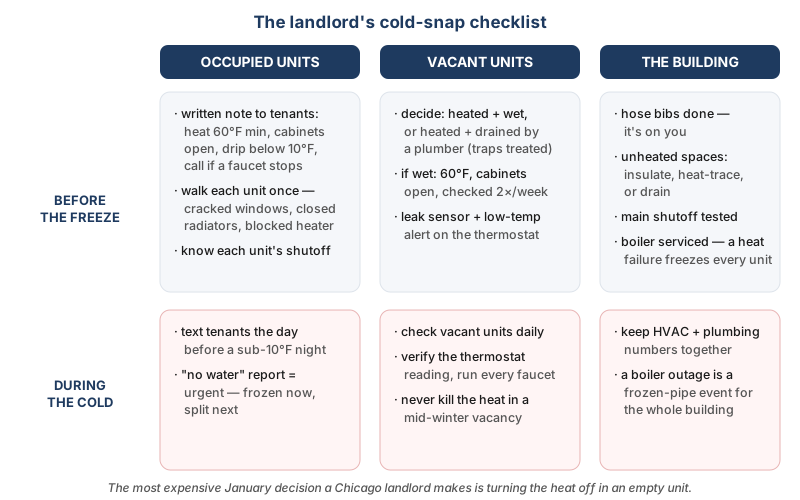
- Send tenants a short written note: keep the heat at 60°F minimum including when away, leave kitchen and bathroom cabinet doors on exterior walls open on the coldest nights, let a faucet drip when the forecast goes below 10°F, and call immediately if any faucet stops running. Put the emergency number in the note. Most leases allow you to require reasonable temperature maintenance; check yours.
- Walk each unit once. You're looking for a window left cracked near a pipe, a dryer vent that doesn't close, a radiator that's been shut off in a room with plumbing, and anything stored against the water heater.
- Confirm you have a working shutoff for each unit and that you know where it is. In many two-flats there's one main and no unit-level valves; adding them is a modest job that pays for itself the first time a tenant's hose bib splits.
Vacant units
- Decide: heated and wet, or heated and drained. For a unit that will be empty more than a few weeks in winter, having a plumber drain the water lines, blow out the traps and add antifreeze to the traps and toilet is the safe option. Heat still stays on (55°F minimum) to protect the structure and the shared risers.
- If you keep it wet, keep it at 60°F, open every cabinet, and have someone physically check it twice a week during cold snaps. A smart thermostat with a low-temperature alert and a water leak sensor by the water heater are inexpensive and will text you before the downstairs tenant does.
The building
- Hose bibs disconnected and shut off. Tenants won't do this; it's on you. The outdoor faucet checklist.
- Common-area plumbing in unheated spaces: the laundry room in a back porch enclosure, the slop sink in the garage, the sprinkler riser in the vestibule — and the sump pit; a pre-winter pump inspection covers the float, check valve and discharge line. Insulated, heat-traced, or drained.
- The main shutoff: know it, label it, and make sure it closes. How to test it.
- Boiler or furnace serviced. In a two-flat with a single boiler, a heat failure is a frozen-pipe event for every unit.
During a cold snap
- Text tenants the day before a forecast below 10°F: cabinets open, faucet drip, heat up, call if anything stops running.
- Check vacant units daily, or have someone do it. Look at the thermostat reading and run every faucet.
- If a tenant reports no water at a fixture, treat it as urgent. A frozen pipe that hasn't split yet is a short visit; one that splits in a wall above an occupied unit is a renovation and a relocated tenant. What to do in the first 30 minutes.
- Keep heat on in a unit a tenant has vacated mid-winter. Turning it off to save money is the single most expensive decision a Chicago landlord can make in January.
Who pays for what
In Illinois, the landlord is responsible for keeping plumbing in working order and for damage caused by the building's systems. A pipe that froze because the tenant turned the heat off entirely may shift some of that, but you'll be proving it after the fact, and your insurance is still the one that gets called first. Landlord policies vary on freeze damage in vacant units; many require the heat maintained and the unit checked at intervals, and some exclude vacancy beyond 30 or 60 days without a vacancy endorsement. Read that section of your policy in November, not in February.
What a plumber can do ahead of time
A winter walk-through of a multi-unit building: identify the pipes at risk, add shutoffs where they're missing, insulate or heat-trace the exposed runs, drain the vacant units, and leave you with a one-page map of every valve. It's a couple of hours and it's the difference between a phone call and a claim.
Call 833-758-6911 to set it up, or for the tenant who just told you the kitchen faucet stopped. A live person answers around the clock; a union plumber from Plumbers Local 130 can be dispatched. Get the price before any work starts.