Why -10°F is different from 15°F
Most Chicago houses handle a normal winter night. Pipes near exterior walls get cold but not to freezing, because the house's heat leaks into the wall faster than the cold pulls it out. Drop the air temperature by 25 degrees and add wind, and that balance flips in the spots that were marginal all along: the kitchen line on the north wall, the run along the sill plate, the pipe in the cantilevered bay. The January 2019 vortex and the Christmas 2022 cold snap each produced a week of burst-pipe calls that started the moment temperatures came back up.
The checklist below is for the night before the forecast drops off the cliff.
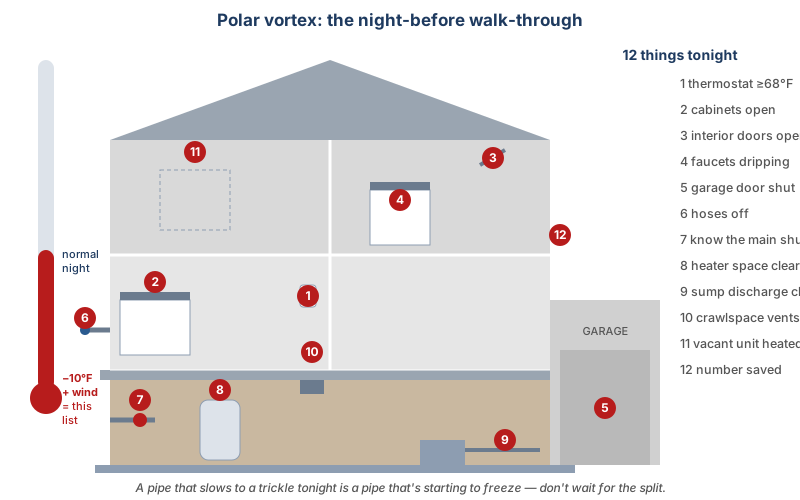
The night before
- Thermostat up, and leave it there. 68°F or higher, no overnight setback, no "away" schedule. The savings from a setback are nothing next to a flooded wall.
- Open every cabinet under a sink that's on an exterior wall: kitchen, bathrooms, the laundry sink. Move the cleaning supplies out so air reaches the back wall.
- Open interior doors so warm air reaches bedrooms and bathrooms on the cold side of the house. Close the fireplace damper if you're not using it.
- Drip the faucets on exterior walls and the ones farthest from the water heater: a pencil-lead stream, hot and cold both. Moving water is much harder to freeze, and an open faucet relieves pressure if ice does form.
- Garage door closed, and stays closed. If there's any plumbing in or above the garage, put a space heater out there on a hard surface, away from anything that burns.
- Hoses off, outdoor faucets shut off from inside if they're the older type. If you haven't done this yet, tonight's the night. Here's the walk-through.
- Find the main shutoff and make sure everyone in the house knows where it is. If a pipe lets go at 3 a.m., this is the only thing that matters. How to test it.
- Check the water heater's space. Nothing blocking the burner's air. Flue connected. If it's in a drafty spot, close the source of the draft.
- Sump pump discharge line: make sure the outlet outside isn't iced over or buried. A frozen discharge line means the pump runs against a plug and burns out — a fall inspection covers the pump, float and line before the freeze.
- Crawlspace vents closed. Access panel shut.
- Vacant units or an empty house: heat on and verified, someone checking daily. The landlord version of this list.
- Save the number. 833-758-6911 answers live at any hour, and a frozen pipe that hasn't split is a short visit if it's caught early.
During the cold
- A faucet that slows to a trickle or stops is a pipe starting to freeze. Leave that faucet open, warm the space it's in, and don't wait to call. The split happens when the ice expands further or when it thaws.
- Don't use a torch, heat gun, or open flame on any pipe. Every vortex produces house fires from this. A hair dryer along an accessible pipe, or a space heater warming the room, is the limit.
- Water heaters work hardest in this weather: incoming water is in the 30s, and recovery is slow. Space out showers. A heater that quits now is often one that was showing signs in October.
- Furnace or boiler fails: that's the emergency that becomes a plumbing emergency within hours. Have the HVAC number next to the plumbing one.
The morning after it warms up
Most burst-pipe damage shows up on the first day above freezing, when ice holding a split pipe together melts. Walk the house:
- Every faucet runs normally, hot and cold.
- Basement floor dry, especially along the front wall and under the kitchen.
- Ceilings under bathrooms and kitchens: no stains, no sag.
- Under every sink: dry.
- Water meter: with everything off, the low-flow indicator (the small triangle or star) shouldn't be moving. If it is, something is leaking somewhere.
- Outside: no ice sheet forming under a hose bib or at the foundation.
Anything wet, anything running when it shouldn't be, or a fixture that still has no water: main shutoff, then 833-758-6911. A union plumber from Plumbers Local 130 can be dispatched; the dispatcher will walk you through containing it while you wait. Get the price before any work begins.
If you came through clean, note the pipes that got sluggish. Those are the ones to insulate, air-seal or reroute before next winter. What actually works in a Chicago bungalow.